What led young men with their whole future ahead of them to board a plane and crash it into an enemy ship with total certainty of death? In the closing stages of the Second World War, Kamikaze pilots chose suicide in the service of the Japanese emperor. Let’s try to understand why this happened.
By April 1945, the German Nazi dictator Adolf Hitler had committed suicide in his bunker in Berlin. Italy’s fascist leader Benito Mussolini was executed and his body strung up in public. The war in Europe was coming to an end. But in the Pacific, Japan – which had allied with Germany and Italy – fought on.

The Chiran Peace Museum in Kagoshima
Just outside the southern Japanese coastal city of Kagoshima, visitors solemnly enter the Chiran Peace Museum commemorating the hundreds of Kamikaze pilots who left from that spot on their fatal last mission. Approaching the entrance, there’s a small forest of stone lanterns along one side of the path, pictured below, each one symbolising an individual Kamikaze who died for the Japanese imperial cause.

Then the visitor is directed through a reconstruction of the Kamikaze barracks and then inside the museum, there are rows of photographs of the pilots, their final letters, and correspondence from family and the emperor cheering them on. The faces staring out from the photos, pilots next to their planes, are intelligent, thoughtful, and young.
Out of the estimated 1,036 Kamikaze who were killed, about 439 departed from Kagoshima. Pictured below is a Kamikaze plane fished out of the sea and displayed in the museum foyer. Image taken from my visit to the museum in March 2026.

Japan’s long war
Europe fought the second world war between 1939 and 1945. The United States entered the fray in 1941 after the Japanese bombing of Pearl Harbour. But Japan had arguably been at war since 1931 when it invaded the north-eastern Chinese province of Manchuria.
Hungry for natural resources and full of imperial ambition, Japan eyed up its neighbours. China was in an almost permanent state of conflict between rival warlords with a central government that struggled to keep control of the vast land mass. Japan spotted weakness and moved in.
The League of Nations (forerunner of the United Nations) condemned the invasion but Japan correctly calculated that Europe and America had no appetite for a global war. Memories of the first world war were still fresh.
But the western powers were eventually drawn in. Japan allied with Hitler’s Germany and Mussolini’s Italy and soon it became obvious that British, French, and Dutch colonies in Asia were in its sights. In Tokyo, fears rose that the United States would enter the war against the “Axis” of Japan, Italy and Germany so the decision was made to destroy the US Pacific Fleet hence the surprise attack on Pearl Harbour in Hawaii in December 1941, killing some 2,300 people.
Kamikaze – sign of desperation
America didn’t forget Pearl Harbour. At the end of the Second World War, US forces led the allied attack on Japan from the south. Territory was lost across Asia, the Japanese imperial navy came under huge pressure, and the Americans were moving inexorably towards mainland Japan.
At this point, Admiral Takijiro Onishi (pictured below) came up with the Kamikaze plan. Special suicidal attack units would be set up to delay the American naval advance. Known as the Tokubetsu Kogeki Tai, they were more commonly referred to as the Kamikaze.

That word means ‘divine wind’ – the ‘kami’ being Shinto spirits that inhabit all parts of nature. The historic reference was the destruction of a hostile Mongol fleet centuries before by typhoons that seemed miraculous at the time and were referred to as divine winds. Here we have the Mongol fleet meeting its doom.

Onishi blended psychology and spiritualism to defend the notion of Kamikaze attacks. He argued that the Japanese soul had the unique ability to face death without hesitation. But when he launched the program, not a single officer trained at the military academies stepped forward for what they knew would be a one-way ticket to the grave.
Instead, the Kamikaze were young, enlisted conscripts and even university students who were allowed to graduate early to join the armed forces. These students were the ones who left behind their written reflections on what they were about to do.
Captain Toshio Anazawa – Kamikaze pilot
At the Chiran museum, you can see the final letter sent by one young pilot, Captain Toshio Anazawa (pictured below). Four days after his death, his fiancée, Chieko, received his correspondence on 16 April 1945. She had sent her love a white scarf which he wore on that last flight.

Toshio regrets that he’s unable to share his life with Chieko any further. He then writes:
“And now, the magnificent day of my attack sortie has arrived. I wanted to write to you. I have so much I want to say. And yet, I know that all of it amounts to nothing other than words of gratitude for your depth of love that you have shown me.”
Then he thanks her family for being – quote – “wonderful people”. But then he says it’s important that they don’t dwell on the past.
“The question is the future. I believe that your intelligence will guide you at all times in judging the proper path. And yet, speaking to the woman in you, I want to convey a few things as a man to whom you were engaged, and as a man who will fall in battle.”
Then he tells her – don’t waste time thinking about the past. Find happiness in the future. He lists the books he’d still like to read and the paintings he still wants to see – including Raphael’s Madonna and Child. Finally, Toshio says Chieko must go forward “cheerfully and brightly” and he will head out into battle smiling.
“From Toshio – to dear Chieko”
The final showdown between Japan and America
In 1944 and 1945, the US Fifth and Third Fleets destroyed the remaining offensive power of the Imperial Japanese Navy at the Battle of the Philippine Sea in June 1944 – and the Battle of Leyte Gulf in October 1944. The US navy also spearheaded the amphibious assaults leading to the major invasions of the Marianas, Philippines, Iwo Jima, and Okinawa.
So, Japan was in a bad way militarily – staring at the prospect of defeat – which culturally was a major shock. Fighting to the death was deeply rooted in the interpretation of the bushido warrior ethos – surrender was dishonour – death was preferable to defeat. One commentator remarked that German soldiers at the end of the Second World War were told to kill – Japanese soldiers were instructed to die.
As an island nation, the Japanese were informed that they had never been successfully invaded…never lost a war in history…total sacrifice for victory was everything. And it was with this mindset that the whole idea of Kamikaze missions was conceived. Japan had lost many experienced pilots making conventional combat less feasible, so they sent less-skilled pilots towards the enemy to crash their planes into ships.
I visited the Yasukini Jinja shrine to the Japanese war dead in April 2026 and here is an image I took of some of those pilots with the imperial flag.

Often described in the western media as fanatics, these young volunteers were guided by intense patriotism, a sense of duty to the emperor, and came under some family pressure to do the right thing. But there is anecdotal evidence that some didn’t want to perform the ultimate sacrifice or had second thoughts at the last minute. What young person wanted to throw their life away?
However, their commanding officers told them – in no uncertain terms – that having committed, there was no going back. They would join many more like them in striking terror into the allied forces. And they certainly horrified newspaper readers and radio listeners in the west – as reports came of up to 7,000 Allied casualties because of their suicidal missions.
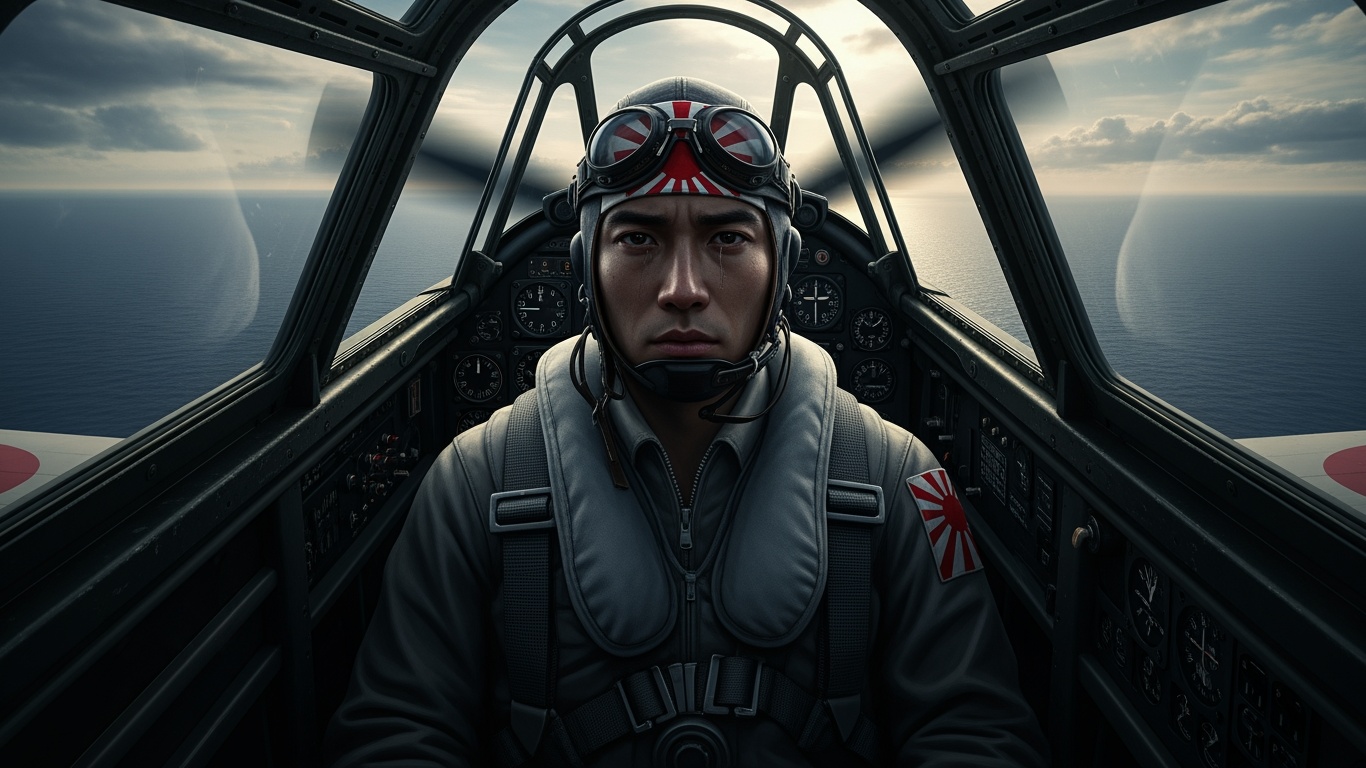
Before a mission, there were various rituals. Ceremonial sake was drunk from special cups. Pilots wrote letters to their families – and even poems expressing their dedication to the cause They wore a Hachimaki – a white headband with the rising sun or slogans like “die and smile” inspired by Samurai tradition. They visited shrines and bowed in the direction of the emperor’s palace.

Some lucky pilots returned to base due to mechanical failures on their old planes – or poor weather – or failure to find a target. This wasn’t necessarily viewed as cowardice because the armed forces didn’t want to waste planes and pilots on an empty ocean.
Pilots who returned too often could find themselves in serious trouble – they might get a transfer – or they might get executed.
One Kamikaze just couldn’t die – he survived three missions – once due to failure to take off – another time due to mechanical failure resulting in an emergency landing – and the third time he crashed into the sea. His name was Takehiko Ena (pictured below) – aged 20 – and an economics student at Waseda University in Tokyo.

He did his flight training in 1943 and was selected for kamikaze duty in 1945. After he crashed into the sea, he swam to nearby Kuroshima Island where he was stranded for over two months before being picked up by a submarine. He survived the war and became a prominent voice, sharing the experience of kamikaze pilots – and honouring the fallen. He died in 2019 at the age of 96.
Ultimately – the whole Kamikaze tactic didn’t work. Japan still lost the war. The man who started it all – Takijiro Onishi – couldn’t believe his ears when the Japanese emperor declared the unconditional surrender of his empire.
Onishi called for millions of Japanese to be prepared to die instead of give in – but the country was literally smouldering – and mourning its dead. In a blaze of fury – Onishi committed ritual suicide – properly referred to as Seppuku – but you may refer to it as Harakiri. It was botched and he took 15 hours to die.
This is his final testimony prior to killing himself which I photographed in Tokyo in 2026.

Below is a newspaper report of his death which uses the unfortunate term “Jap” but reflects the attitudes of the time, which in an American newspaper as not going to be at all sympathetic. The suicides of top Japanese officials were treated with contempt or even mirth. In his final testament he described the Kamikaze pilots he created as “human bullets”.

NOTE ON THE AUTHOR:
Tony McMahon is an investigative historian often see on TV: https://tony-mcmahon.com/
He is the author of several books on different historical topics including the Knights Templar: https://www.pen-and-sword.co.uk/The-Knights-Templar-Hardback/p/51654
Tony is the co-host of the Talking Templars podcast on YouTube and other channels.