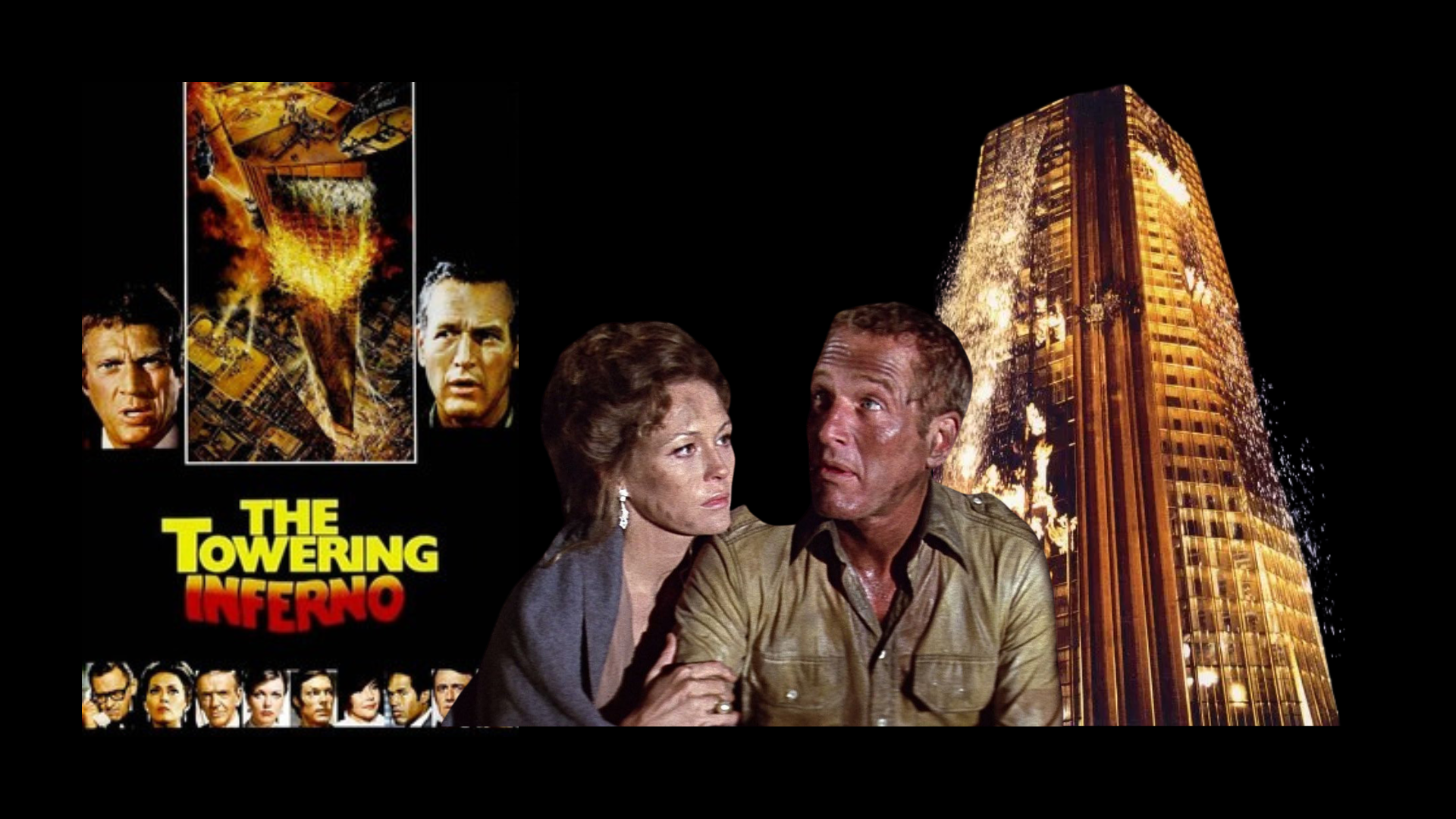
I’m sitting here on a lazy afternoon re-watching the 1974 classic disaster movie The Towering Inferno for the umpteenth time. A star studded cast, including Faye Dunaway, Paul Newman, Steve McQueen, and Fred Astaire, struggle to escape from the mother of all skyscraper fires. But how many towering infernos have there been in reality?
As buildings got ever taller in the 20th century, fire chiefs warned, as they do in the movie, that trouble was brewing if safety was compromised. When The Towering Inferno was released in late 1974, the Firefighters Union in the United States organised screenings of the movie as a cautionary tale. In Wichita, for example, journalists were guests of the union at the movie premiere. Chief Fire Inspector Robert Fraley warned that if the local Holiday Inn Plaza was ablaze, firefighters would struggle to reach it.

Little known fact but The Towering Inferno movie was based on two books. One was The Tower by Richard Martin Stern, based on a fictional skyscraper, the World Tower Building, adjacent to the real-life World Trade Center. The other book, The Glass Inferno by Thomas N. Scortia and Frank M. Robinson (a speechwriter for the assassinated gay politician Harvey Milk), included many of the movie’s most memorable plot points such as the cost cutting on building materials and the blowing up of the huge water tanks to douse the inferno.
With the benefit of grim hindsight we now know that while the imaginary World Tower Building was the stuff of imagination, the World Trade Center – both of its twin towers – collapsed spectacularly after terrorists flew passenger jets into them. Although the 1970s architects could not have anticipated such an appalling act – even in a decade noted for its high level of hijackings – subsequent investigations revealed how the design of the skyscrapers allowed them to collapse like a pack of cards.
The year before, 2000, I visited New York and went up the World Trade Center to the One World Observatory. My main memory is that the lift shaft was very much a wind tunnel. You could feel the elevator being slightly buffeted by air currents as we shot up.
Unlike the Empire State Building, the view at the top was an indoor experience, gazing at New York below through smoked glass. Sitting in the plaza afterwards and gazing up, the towers truly seemed to scrape the sky. The scene as they fell is still unimaginable.
The Winecoff Hotel fire
There was an early warning of the disasters to come in 1946 when the Winecoff Hotel fire in Atlanta, Georgia, claimed 119 lives. Below is a Pullitzer Prize winning photo of a survivor, Daisy McCumber, about to leap to safety, though she suffered severe injuries.

The Winecoff Hotel, opened in 1913, was a mere 15 floors high but firefighters were unable to reach the upper floors because their ladders were too short. The man pictured below lost his recent bride in the fire while schools in the area prepared to bury 28 members of the YMCA, boys and girls.

This is contemporary newsreel footage screened in cinemas showing the devastation caused by the Winecoff Hotel fire and the hopeless situation for those inside.
DISCOVER: The 1755 Lisbon earthquake disaster
Routine absence of safety features in skyscrapers
Three years before The Towering Inferno got its cinema release, I was astonished to read an American newspaper article from 1971 where New York’s city authorities announced that fire drills would now be mandatory in these buildings. “They will be much like the air raid drills in World War II”.
Plus skyscrapers would need to appoint a dedicated fire safety director, ensure alarms are sounded, muster workers into agreed areas, and issue clear instructions on how to find fire exits. Incredibly, none of these practices were obligatory beforehand! In addition, the American Insurance Association demanded that flammable furnishings be banned and automatic water sprinklers should be introduced.
The Joelma Building Fire
In the same year that The Towering Inferno came out, 1974, a block in the Brazilian city, São Paulo, caught fire when an air conditioning unit overheated. An estimated 179 people died. There were no fire sprinklers, no fire alarms, and no emergency exits. When the city’s fire chief, Flores Ribeiro, condemned the city’s lack of safety rules, officials considered firing him. Ribeiro also pointed out that the number of firefighters in São Paulo hadn’t risen since the year 1940.
DISCOVER: Biggest man-made explosions in history
The 9/11 effect
The 9/11 terrorist attack on the World Trade Center, in September 2001, provoked a great deal of soul searching over the addiction to building ever more skyscrapers. Yet when polled, 70% of Americans were still in favour of constructing these behemoths, though a third were more nervous about walking into high rise buildings. However, these fears soon subsided.

At the end of The Towering Inferno, fire chief Steve McQueen asks skyscraper architect Paul Newman to consult professionals like him next time he’s designing a monster building – then maybe disasters can be averted. A forlorn hope!

NOTE ON THE AUTHOR:
Tony McMahon is an investigative historian often see on TV: https://tony-mcmahon.com/
He is the author of several books on different historical topics including the Knights Templar: https://www.pen-and-sword.co.uk/The-Knights-Templar-Hardback/p/51654
Tony is the co-host of the Talking Templars podcast on YouTube and other channels.