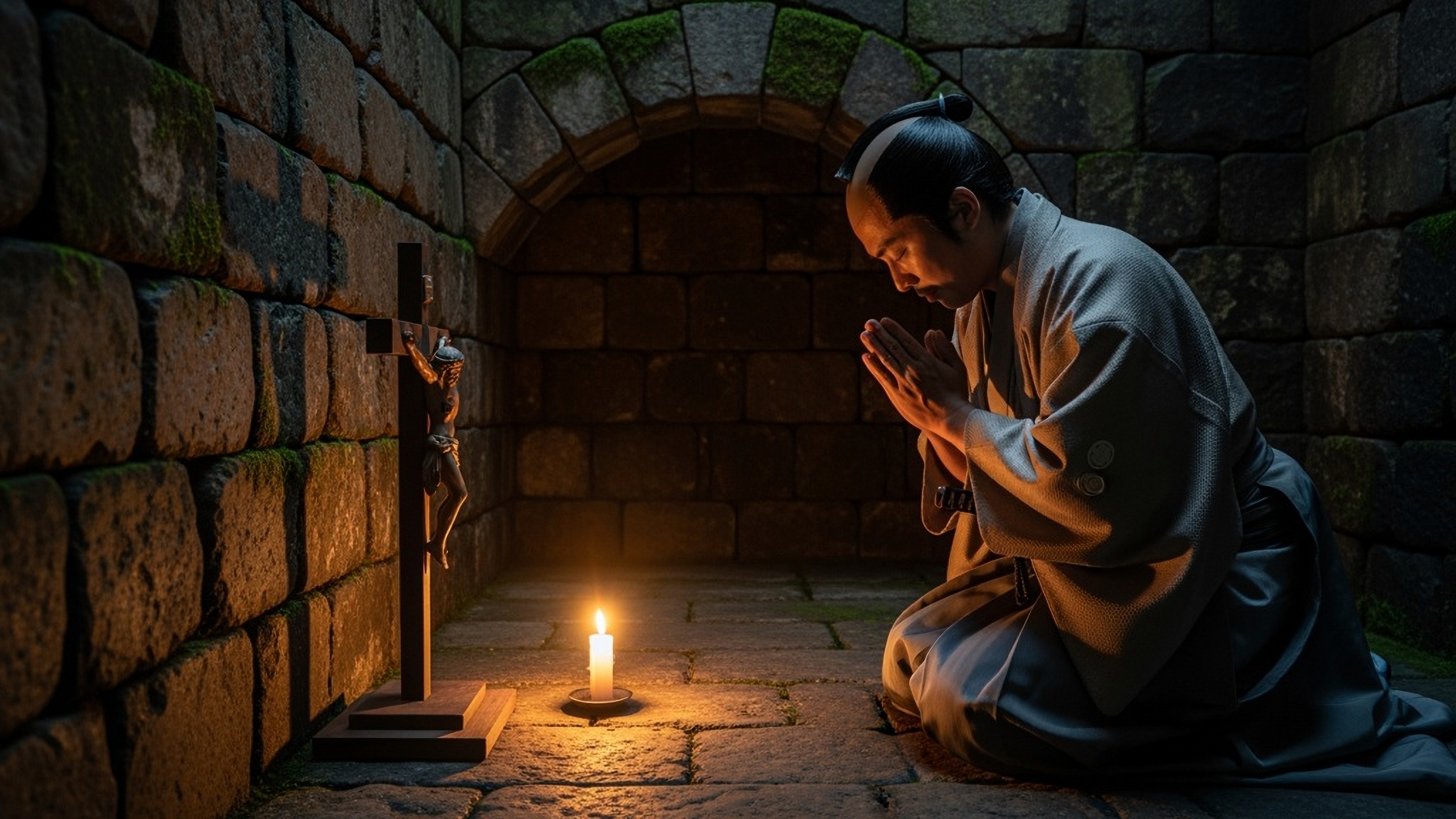
It’s easy to imagine that Japan is home to just two religions: Buddhism and Shinto. But for 500 years, there has been a thriving Christian community although for centuries, it had to pray in secret, avoiding the gaze of the authorities. So-called “hidden Christians” worshipped Christ and the saints, blending Roman Catholicism with indigenous rituals. Up until the mid-19th century, they faced execution if discovered.
Clues to the Hidden Christians
So, who are these mysterious Christians who lived in the shadows for so long? I’ve just returned from a month long stay in Japan and found some clues. At the National Museum in Tokyo, there is a gallery full of statuettes and other items confiscated by the magistrate’s office in the city of Nagasaki. One of these is pictured below – an image taken during my visit to the Tokyo National Museum in April 2026.

Most of the displayed items are glazed porcelain figures of the Buddhist bodhisattva Kannon, imported from southern China, which were re-versioned in private by Japan’s hidden Christians as the Virgin Mary and baby Jesus. If they thought that would fool the authorities, they were badly mistaken. The true significance was fully realised and they were impounded.
Up until 1873, when the ban on Christianity was lifted in Japan, Christians faced capital punishment. During my research, I found this newspaper report from 1868 on the mass execution of Christians in Nagasaki. The journalist was incredulous that the Christians concerned were not recent converts but descendants of those brought to the Catholic faith by Portuguese Jesuits in the 16th century. The “old stock” as the newspaper called them – Hidden Christians in other words.

Nagasaki – centre of Japanese Christianity
In Nagasaki, which I visited in April 2026, there are two major Christian churches – one of which is the Urukami Cathedral. Just inside the entrance is a sacred image of the Virgin Mary – the Hibaku no Maria.
It’s all that remains of a statue of the mother of Christ that was incinerated by the atomic bomb dropped on Nagasaki in 1945. With no eyes and a charred face, it’s a haunting piece of religious art. But the city’s Christians view it as a miraculous survivor from the nuclear attack America launched in the closing stages of World War Two. Here is an image I took on my visit to Nagasaki.

In Japan today, there are approximately 1.9 million Christians, about 1% of the national population. They include Eastern Orthodox and Protestant, but the oldest and most prevalent denomination is Roman Catholic. The highest density of Catholics can be found in Nagasaki but how did they come to be there?
The Portuguese bring Christianity to Japan
Today, Nagasaki is a bustling city. Hard to believe it was devastated by one of two atomic bombs dropped by the United States in the summer of 1945. The other was detonated at Hiroshima. Originally, the plan had been to nuke Kyoto but at the last minute, it was decided that Nagasaki would be subjected to the atomic horror.
Nagasaki was an unusual choice given its large Christian presence. It’s long been a port city connecting Japan to the outside world and was founded by Portuguese Jesuits in the 16th century who arrived in Japan during Portugal’s relentless global maritime quest for spices, gold, and converts to Catholicism.

The Portuguese had footholds in India and Malacca and arrived in Japan in 1543. With the permission of the local warlord, they took control of a fishing village and turned it into a commercially successful entrepot: Nagasaki. Still today, at local bakeries you can buy Castella cake, a Portuguese sponge dessert. Also, if you’ve ever eaten tempura then know that it was Portuguese sailors who taught the Japanese how to deep fry their food.
Back in Europe, Portugal and neighbouring Spain were in the throes of a Catholic fervour, stamping out the last remains of what had been a country of three faiths – Christianity, Judaism, and Islam. From now on, there would be just one faith: the Roman Catholic church. Anybody disagreeing faced the torture chambers of the inquisition and being burned at the stake.
This idea of the need for religious uniformity was brought to Japan. While they were in no position to overthrow the prevalent state-backed Buddhist-Shinto religion, they could make inroads by converting as many Japanese as possible to Roman Catholicism.
Jesuits set to work in Japan
The Portuguese brought a relatively new brotherhood of Catholic priests to Japan: the Jesuits. They had been set up specifically to counter the growing Protestant Reformation in Europe – Christians who no longer accepted the authority of the pope or the Catholic sacraments. These were well-trained, theologically steeled, black-robed clerics who won over Japanese peasants and nobles alike to Roman Catholicism.
Chief amongst them was Francis Xavier, a co-founder of the Jesuit order, who was based in Portuguese-governed Goa, in India. A Japanese man called Anjiro travelled from Kagoshima to see Francis and urge him to conduct missionary work in person in his country. It’s very likely that Anjiro had been charged with murder back home. Francis absolved his sins and baptised Anjiro as Paulo de Santa Fe. He would become an interpreter and guide.

Francis Xavier made quite an impact in Japan, evidenced by statues of him you can find in Kagoshima, Nagasaki, and Tokyo. In a few years, thousands of people had swapped the Buddha for Christ.
The Shogun versus the Jesuits
Anybody who has read the novel Shogun, or seen the recent streamed TV series, will know that the rise of the shoguns spelt big trouble for Japan’s Roman Catholics. When the Jesuits started their missionary work, the country was divided between rival warlords with little by way of a central authority.
However, Portuguese traders sold matchlock guns to the Japanese and this transformed local warfare, undermining the traditional samurai, and democratising the battlefield. Now, anybody who knew how to load a gun could kill in battle. Rather like the chivalrous knights of medieval Europe, the samurai were rendered obsolete by the arrival of new military technology. Though they would soon bounce back.
Power rapidly centralised into the hands of one clan, the Tokugawa, who assumed the role of shogun – or military strongman. From the start of the 17th century until the mid-19th century, the Tokugawa shogunate wielded true power in Japan, ruling from Edo (later Tokyo), while the emperor resided in impotent splendour in Kyoto with ceremonial duties only.
Brutal treatment of Japanese Christians
From the start of the shogunate, Christians were viewed as inherently disloyal. Buddhism reinforced the power of the shoguns while Christianity seemed to undermine it. At least that was the perception of the shoguns. The result was a series of pogroms against Christians that included the Great Genna Martyrdom at Nagasaki in 1622 and the Great Martyrdom of Edo in 1623.

In 1637, a revolt of mainly Christian Japanese peasants – the Shimabara Rebellion (pictured below) – convinced the shogun that the Jesuits and those they had converted were nothing but trouble. There were so many Catholics in Nagasaki that it had become known as the “Rome of Japan”. For the Shogun, it was time to snuff this imported religion out.

The methods used by the shogun to terrify local people away from Roman Catholicism were undeniably barbaric – including crucifixion. Though it’s worth bearing in mind that equally dreadful things were being done by Christians to other Christians in Europe at this time on both the Protestant and Catholic sides.
In Nagasaki’s Nishizaka Park, you can visit the Twenty-Six Martyrs Monument that memorialises the execution of 26 Christians – six foreign missionaries and 20 Japanese converts. It has a very impressive carved bronze relief by Yasutake Funakoshi and was unveiled in 1962 (pictured below).

DISCOVER: What was the Black Dragon secret society?
Kakure Kirishitan – Hidden Christians of Nagasaki
And so, Japan’s Christians went into hiding from a vengeful Shogun. Those that were exposed, often informed on by their neighbours, faced imprisonment, torture, and execution. They tried to make their prayers sound like Buddhist chants and their icons pass off as Buddhist deities, but these ruses didn’t always work.
As late as 1796, I found a newspaper report about towns in Japan where Christians had once been a significant visible presence, trampling on images of the Virgin Mary and Jesus every year as a kind of cleansing ritual. Men, women, and children were encouraged to show their contempt for Christianity and the Portuguese who had brought that faith to their country. These Christian images were made of cast copper and put away afterwards for a repeat performance the following year.
In the mid-19th century, as the shogunate ended and Japan opened to the west again, Christianity was un-banned. In Nagasaki, this led to the construction of the Oura church in 1878, originally built for European Christians living in the city.
The presence of the Hidden Christians, often living in villages and the hills around Nagasaki, wasn’t known to the Europeans. Until one day the French priest in charge of the Oura church arrived one day to find a group of Japanese people standing outside asking him to open the doors. He asked who they were and an elderly woman responded:
“The heart of all of us is the same as yours. Where is the statue of the Holy Mary?”
The Hidden Christians had come out of hiding – descendants of those who had participated in the Shimabara Rebellion. A white marble statue of the Virgin Mary was imported from France to commemorate the event. As thousands of Hidden Christians began to emerge in the Nagasaki area – Pope Pius IX referred to this as “the miracle of the Orient”.
Sadly, many of those Hidden Christians would die in the atomic bomb dropped on Nagasaki in 1945. I visited the Nagasaki Atomic Bomb Museum in April 2026 and took an image of these rosary beads fused together during the nuclear explosion.

In March/April 2026, I spent a month in Japan, South Korea, and Taiwan travelling across the region.
NOTE ON THE AUTHOR:
Tony McMahon is an investigative historian often see on TV: https://tony-mcmahon.com/
He is the author of several books on different historical topics including the Knights Templar: https://www.pen-and-sword.co.uk/The-Knights-Templar-Hardback/p/51654
Tony is the co-host of the Talking Templars podcast on YouTube and other channels.