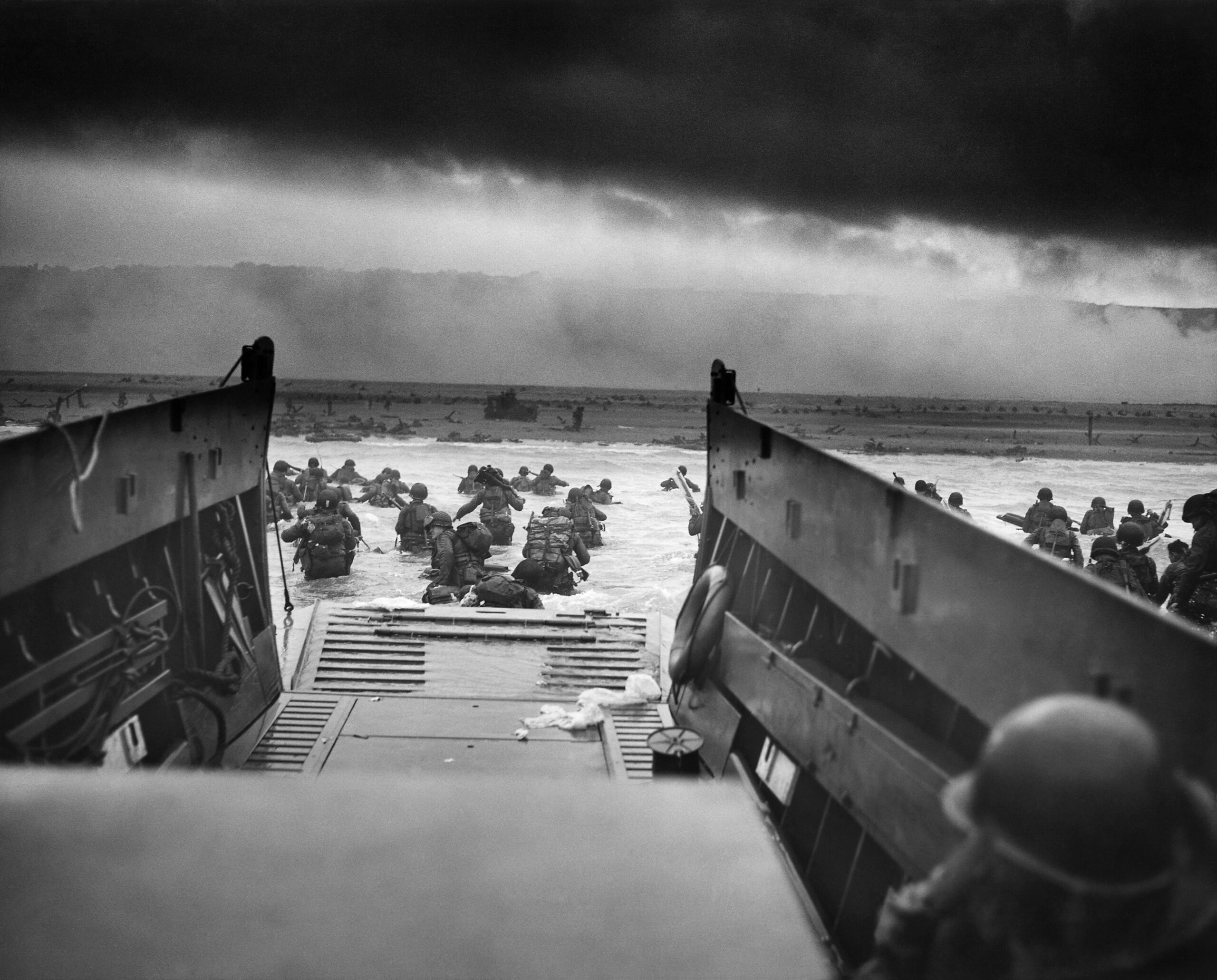
On Tuesday June 6, 1944, the biggest seaborne and airborne invasion in history took place on the northern coast of France. The Normandy Landings – or Operation Overlord – more often referred to simply as D-Day. This was the moment when the Allied Forces began the process of liberating France, and the whole of western Europe, from Nazi control. Up until that moment, Hitler’s armies had conquered most of Europe except neutral Sweden and Switzerland. Spain and Portugal were not invaded by Germany but had fascist dictatorships. D-Day signalled the end of the Third Reich.
Reversing the shame of Dunkirk
In the first year of World War Two (1939-1945), there was a tense stand-off between British, French, Belgian, and Dutch forces on one side and the Germans on the other. This is sometimes referred to as the “phoney war”.
But in 1940, Hitler’s armies moved decisively into the Netherlands and then France, easily overcoming defences put in place after the First World War (1914-1918). Penned into the French port of Dunkirk, British troops were then forced to evacuate across the English Channel, kicking off a massive escape operation that became the stuff of heroic legend.
However, to British political and military leaders at the time, it was a source of privately expressed shame and anger. Hitler invaded France and soon was in control of western Europe. Not since the French Emperor Napoleon had brought Europe under his sway 130 years earlier had Britain faced such an appalling situation. Plans got underway to reverse this humiliation and when the United States entered the war, those plans accelerated.
From 1943, Operation Overlord moved into top gear. By then, Hitler was facing major setbacks on the eastern front against the Soviet Union. The Allies became more confident that the Germans could be beaten in the west.

The ambition of D-Day
The scale of the invasion was unprecedented. The target beaches on the Normandy coast were divided into five areas named: Utah, Omaha, Gold, Juno, and Sword. American forces were focused on Utah and Omaha while British, Canadian, Dutch, Norwegian, and other forces concentrated on Gold, Juno, and Sword.
The rate of death and injury varied considerably between beach landings. On Utah, out of 23,000 American troops who landed, there were only about 197 dead or wounded. In contrast, Omaha saw a devastating scene of bloodshed portrayed in the Hollywood movie, Saving Private Ryan. About 34,000 Allied troops piled on to the beaches and 2,400 were mown down by concerted fire.
Gold saw 25,000 land, sustaining just 400 casualties. Those troops were drawn from the British 50th (Northumbrian) Division which had served at Dunkirk, north Africa, Sicily, and then back to England to secretly train for D-Day. On Juno, a combined Canadian and British force of 21,400 saw 1,200 injured or worse. While on Sword beach, 29,000 landed with 630 falling victim to enemy fire.
In total, 132,000 troops landed from seven thousand vessels. They soon had to reckon with German coastal defences that had been improved in recent months. From D-Day until the end of Operation Neptune on June 30, a staggering 850,000 Allied soldiers set foot on the beaches. By August, when the Battle of Normandy ended, that figure had reached two million. About 400,000 vehicles were involved and millions of tonnes of provisions. This was a vast logistical achievement that finally buried the shame of Dunkirk.

The airborne invasion on D-Day
Airplanes were still in the their first fifty years yet cities across Europe had endured bombing from above with Dresden reduced to an inferno and much of London destroyed – up to a fifth of the city. For two years up to D-Day, the British trained glider pilots, paratroopers and airborne fighters for maximum impact.
The combination of forces arriving in a coordinated manner by land and air was devastating for the Germans. On June 6, some 18,000 troops of the US 82nd and 101st Airborne Divisions and the British 6th Airborne Division were dropped into Normandy.
What does D-Day mean?
Ever since 1944, many people have wondered what exactly is meant by the term “D-Day”? It was explained in contemporary newspaper articles, which I’ve researched, as simply referring to THE day for action. The term began to be used in World World One. So, planners would say that an operation would commence at “H-Hour” on “D-Day” when there was still uncertainty over the exact date and time for commencement.
Even when the date was known, the term would still be used as a security precaution. So, if the military was referring to action to be taken after the initial invasion, they might say it would happen on “D-Day plus one” or for the day before, “D-Day minus one”.
Deception campaigns in the lead up to D-Day
The Third Reich knew that it was a matter of time before the Allies launched a coastal invasion on northern France. So, the Allies engaged in subterfuge and trickery to try and confuse the Germans as to their plans. Under Operation Fortitude and Operation Bodyguard, the enemy was led to believe that the invasion would occur at a different point on the French coast than Normandy.
The deception was helped by two key factors. Firstly, the British had cracked the German secret code – Enigma – without the Nazis realising. Codebreakers at Bletchley Park – an intelligence centre in England – had been eavesdropping on German conversations for over a year before D-Day. So, they knew exactly how the Nazis were reacting to the threat of an invasion and whether they had guessed the target areas. At its height of activity, seven thousand people were working at Bletchley Park decrypting five thousand Enigma code messages every day.
And then there were the double agents. MI5 ran what was termed the Double Cross System where captured Nazi spies were convinced to spy on their own country. So, information was gathered by treacherous agents from their controllers within the Third Reich – unaware their agent had swapped sides. One very prolific double agent was Juan Pujol García who set out to become a double agent for the British from day one. He basically convinced the Nazis he was fanatically pro-Hitler; got Berlin to fund a network of contacts that was entirely fictitious; and then reached out to the British – feeding bogus material to his Nazi handlers. MI5 called him Agent Garbo.
Dummy tanks and a fake American army stationed in south-east England added to the confusion. By the time D-Day was underway, the bulk of German forces were nowhere near. Hitler was convinced the British would choose the shortest route to France going from Dover to Calais. He did not expect Normandy. On D-Day, fake dummies were even dropped by parachutes on the Calais area to create the impression that an invasion was underway.

Rommel and the German response
From 1942, Hitler ordered a string of defences to be put in place from Spain to Norway – the Atlantic Wall, as it came to be known. Cement bunkers, that can still be seen, dotted the coastline facing England plus a huge amount of mines and barbed wire.
German infantry forces were spread quite thinly along the line and bulked up by veterans of the Eastern Front. These soldiers had experienced the gruelling war against the Soviet Union and being posted to the Atlantic Wall must have been a welcome break…until D-Day.
The man put in charge of the German defences was Field Marshal Erwin Rommel – who had served the Third Reich in North Africa. He reported to Field Marshal Gerd von Rundstedt, overall commander of the Reich’s western forces. Thinking that in 1944, an invasion would happen in May and hit Calais first, the Germans lowered their guard when nothing happened and June brought stormy weather in the English Channel. Rommel was so convinced that the invasion was off that he left the front to go and visit his family in southern Germany.

The Allied Supreme Commander (and future American President) was General Dwight D. Eisenhower. Based in London, he seized on a lull in the bad weather to launch on June 6, 1944. Airborne forces went in first and the French Resistance was urged to conduct sabotage operations immediately. The British Field Marshal Bernard Montgomery – better known as just “Monty” – took command of the Normandy Landings.
Monty had led the Allies to victory in North Africa at El Alamein; been a key figure in the invasion of Sicily and then the Italian mainland; and now took control of British and Canadian ground forces in Operation Overlord. He had fought Rommel in North Africa and now faced the steely German general again.
In trying to take the French city of Caen – Monty ran up against determined opposition from the 12th SS Panzer Division Hitlerjugend. This was a tank division made up of dedicated former Hitler Youth members. Its commander, Kurt Meyer, would be convicted of war crimes after the Second World War ended, though he avoided being hanged.

Incredibly, when faced with the D-Day news, Hitler and the Nazi high command were still perplexed. Was this yet another diversionary ruse and Calais was still going to be the main arena of invasion? Should German forces be sent to meet the Allies or beat a tactical retreat? Hitler had what can only be described as a crazily optimistic scenario in his head. The Allies would be driven back into the sea and then the Third Reich could focus fully on the Soviet Union – and win the war. His generals were not convinced.
Rommel and Rundstedt had a tense meeting with Hitler on June 17 where Rommel boldly told the Führer that at the very least, German forces needed to get out of range of Allied warships by moving inland. But he then dared to suggest that with things going badly wrong on the Eastern Front, Hitler might want to bring the war to an end. Rommel was told, in no uncertain terms, to leave politics to Hitler and get on with winning the war.
The Allies were aware to a degree of these tetchy exchanges among the German leadership. British newspapers goaded Rommel gleefully saying that his position was now under threat and that top Nazis were falling out with each other.
The following month saw an attempt by German army officers to kill Hitler at his bunker with an explosive device. Rommel, who had once enjoyed Hitler’s complete trust, was implicated but given the opportunity to take his own life. Hitler was not keen on a high-profile show trial of Rommel at this delicate moment in his dictatorship. In October, Rommel obliged with a cyanide pill.
German newspapers reported that Rommel had been fatally injured while in his car in Normandy, after it came under fire, sustaining a severely fractured skull when he was thrown from the vehicle. That incident did occur but it had not killed him. It was a visit by senior officers to relay the choice between a public trial and execution or a more private and dignified exit from this world that resulted in his suicide.

American losses
D-Day was the beginning of a year long slog to reach Berlin and topple Hitler. Many American troops would die in this final stage of World War Two. The obituaries appeared regularly in newspapers across the United States of American soldiers who had been killed engaging the enemy.
For example, on June 19, 1944, it was announced that a 35-year-old medical doctor – Capt. Harry T. Singley – had died during the D-Day invasion. He was from South Jersey and had joined the armed forces just two years before. He specialised in obstetrics at Atlantic City Hospital. On July 15, 1942, he enlisted with the Army Medical Corps. His death left three young children and a widow plus two sisters and his father. A family in mourning. That tragedy was repeated many times in the months that followed D-Day.

D-Day did not end the Second World War but from then on, the Third Reich was in decline. Rommel was right that once the Allies had a firm foothold on the French coast, it would be very difficult to stop them rolling forward.