


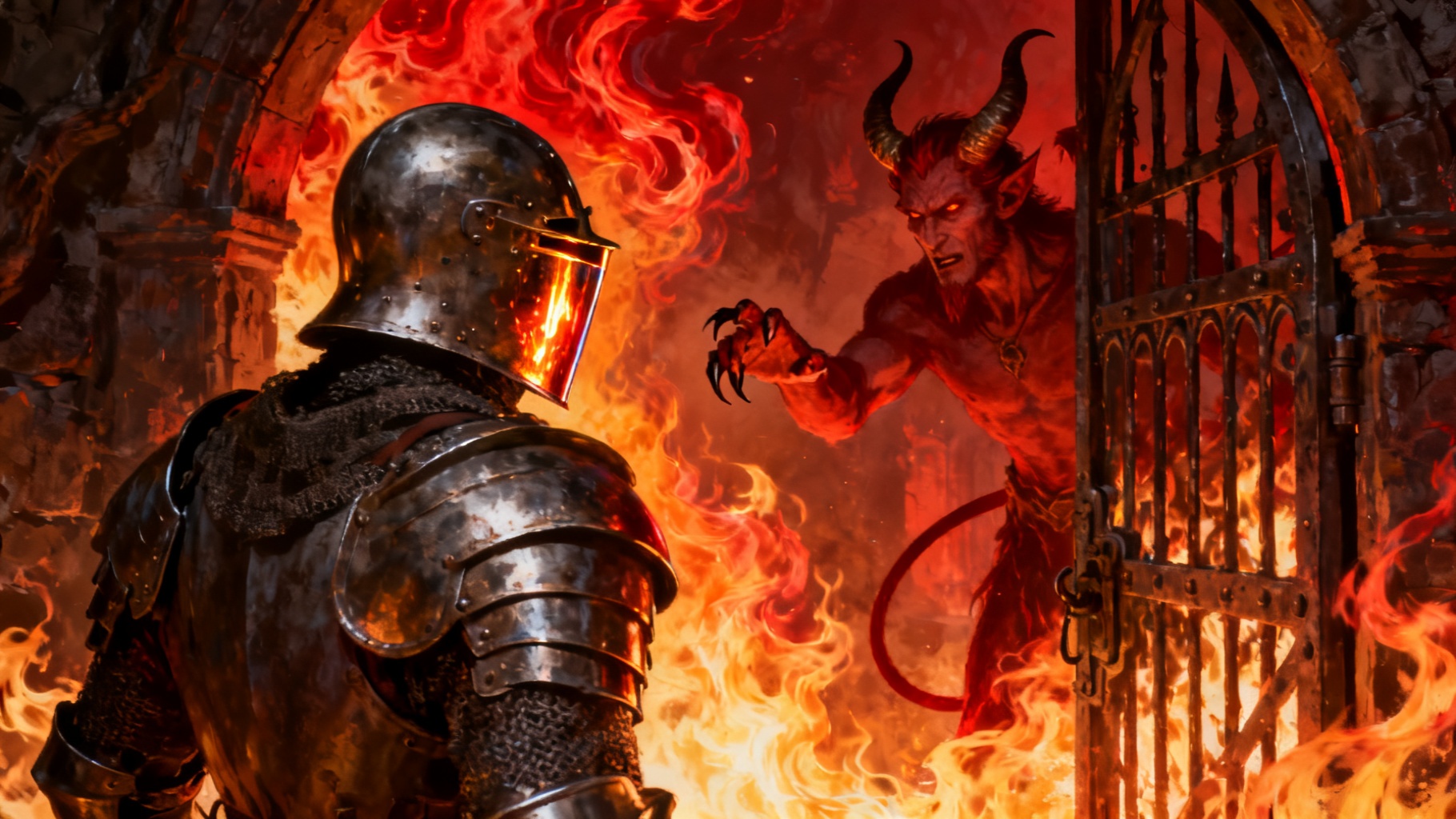
All over Britain and Europe, I’ve seen depictions of hell painted on the walls of medieval churches clearly intended to terrify the faithful as they attended mass. Centuries ago, most people were illiterate. So, the consequences of sin needed to be relayed pictorially. There was the gaping mouth of hell. Devils prodding the damned towards the eternal inferno – pain and agony without end down below.
In the northern English city of York there’s a forbidding object in the crypt of the city’s minster (large church with cathedral status). It’s called the Doomstone. Engraved into it is a scene no medieval Christian would be able to get out of their head. Lost souls are pushed by demons into a fiery cauldron. At the top left you see a miser carrying bags of gold. He has committed the sin of greed. To his right, a woman is displaying feelings of lust.

DISCOVER: The Harrowing of Hell – when Jesus entered Satan’s domain
The hellish vision of Tundale
One man, an unrepentant sinner, got a sneak preview of what lay ahead for him if he didn’t mend his ways.
In the 12th century, a knight named Tundale died at dinner. He was dead, by all accounts, for three days. When he revived he dictated a vision to an Irish monk named Marcus, who wrote it down around 1149. What Tundale had seen was unforgettable: a valley of forge-fires where a monster called Acheron straddled a frozen lake, swallowing damned souls by the thousands and excreting them through its bowels as burning sparks.
He had walked a plank a foot wide over a pit of iron nails while carrying a cow, pursued by demons. He had watched a blacksmith’s forge where souls were beaten flat, stacked like sheets of iron, then reanimated to be beaten again.
The Vision of Tundale was among the most widely copied texts in medieval Europe. Manuscript copies survive in 15 languages. That popularity was not accidental. It reflected a medieval preoccupation so consuming, so architecturally embedded in churches and so institutionally cultivated by clergy that it shaped nearly every dimension of social life: the terror of hell.

What Hell Actually Was
Hell was going to be physically painful. Torment such as you could not imagine. And Thomas Aquinas, the 13th century theologian, observed that while the damned suffered, they would turn their heads upwards to see the saints living happily in heaven:
“Even as in the blessed in heaven there will be most perfect charity, so in the damned there will be the most perfect hate. Wherefore as the saints will rejoice in all goods, so will the damned grieve for all goods. Consequently the sight of the happiness of the saints will give them very great pain.”
What would hell’s burning feel like? Gregory the Great, whose sixth-century Dialogues remained required reading for medieval clergy, was precise: the fire of hell does not consume what it burns. It tortures without destroying. The damned are preserved in agony indefinitely — not killed by it, not numbed to it, but perpetually sensitive and perpetually burning. Aquinas added a refinement: hellfire does not give off light. It burns, but the damned see nothing. Darkness and flame exist simultaneously, a darkness you can feel but cannot see by.
The cold was as terrifying as the fire. Drawing on the Book of Job’s reference to “the shadow of death” and developed through visionary literature, many medieval accounts described hell as alternating between extremes. Tundale passes through a region of intolerable heat and then a region of such cold that souls snap like glass. The Vision of Drythelm, recorded by the Venerable Bede in his Ecclesiastical History of the English People (c. 731), describes a valley lit by alternating flames and hailstorms, souls tossed back and forth between them — a physical image of souls caught between torments with no rest and no hope of either ending.
The smell was described as well. Hildegard of Bingen, the twelfth-century Benedictine abbess and visionary, wrote in her Scivias of hell as a place of “foul-smelling smoke” and a “stench of putrefaction.” This was not rhetorical. Hildegard experienced her visions as sensory events and described them with characteristic precision. Hell stank because corruption was its essence — the final state of a soul that had chosen rottenness over the incorruptible God.
At the convent of Santa Clara in Porto, Portugal, I saw this stark image of hell with sinners reaching up, hoping to be relieved of their agonies. Note on the right, a papal tiara in hell.

The Architecture of Torment
Medieval hell was not a single chamber but a structured landscape, and its geography varied according to the sins being punished. This made theological sense: justice required proportion. The Apocalypse of Paul — a late antique apocryphal text that circulated widely throughout the Middle Ages — describes a river of fire in which the damned are submerged to varying depths depending on the gravity of their sins. Some are in it to the knees, some to the navel, some submerged entirely. Priests are submerged deeper than laypeople for the same sin, because they knew better.
Again, an image from a church in Portugal – this time in the northern town of Viana do Castelo. Note the monk on the right who is not being forgiven for his transgressions and is immersed in the flames.

Dante Alighieri’s Commedia (c. 1308–1320), the most architecturally elaborate vision of hell ever composed, stands at the culmination of this tradition. His Inferno is a vast inverted cone descending to the center of the earth, with nine circles arranged by the nature of the sin — incontinence at the upper levels, violence in the middle, and fraud at the deepest. The very geography encodes a moral philosophy: sins of the intellect (betrayal, treachery) are worse than sins of passion, because reason is closer to God and its corruption is therefore worse.
But Dante was building on centuries of visionary literature that had already mapped the underworld. In the Vision of Alberic of Montecassino (early twelfth century), a nine-year-old boy is taken through hell by a white dove and a great man who may be Virgil — a direct antecedent of Dante’s guide. The boy sees rivers of fire, pools of pitch, mountains of ice, wheels of flame, serpents, dragons, and specific punishments for specific sins: the proud hang by their tongues, the unchaste are bitten by serpents at the organs of their sin, the gluttonous are forced to eat filth. The specificity was the point. Hell was not abstract. It was designed.
DISCOVER: Is Houska Castle a gateway to hell?
The Devil and His Servants
Medieval theology inherited a complex Satan from scripture and patristic literature, but popular imagination elaborated him into something far more vivid. The Satan of the Book of Job is a member of the divine court, a prosecuting attorney. The Satan of Revelation is a dragon. By the high medieval period, he had acquired a composite form that combined terror with a strange grotesque comedy.
He was enormous. The Vision of Tundale describes Acheron — a hell-monster identified with Satan — as so vast that he straddles a frozen lake like a bridge, his body a dark mountain of flesh. Hildegard of Bingen envisioned Satan as a formless, worm-like mass of darkness in the Scivias, stripped of the beauty he had possessed as a bright angel. The contrast was deliberate: Satan was defined by privation, by the absence of the beauty and order that characterize God’s creation.
But in other traditions he was far more physical. He had horns (borrowed from Pan and the ancient terror of wild places), a tail, cloven hooves, and black skin that recalled the smoke and soot of hellfire. He often appeared with multiple faces — the better to devour souls simultaneously. The Junius Manuscript, an Old English collection including Christ and Satan, describes Satan as enormous, dark, and howling — a figure of immense power reduced to impotent rage by his own choice.
His demons were similarly physical. Medieval demonology, elaborated in texts like Peter of Cornwall’s Book of Visions (c. 1200), described them as fallen angels who retained something of their angelic nature — they were real, they could move through the world, and they actively worked to bring souls to damnation. They were not mere symbols of sin but agents of it. They whispered temptations, exploited moments of weakness, and attended at deathbeds to claim souls whose final balance had tipped toward vice. The moment of death was a contested threshold: angels and demons weighed the soul, quite literally in many accounts, and demons would add their accusations to the scales.
This gave the devil a terrifying immediacy. He was not somewhere else. He was here, now, watching.
The Church and the Management of Fear
The medieval church did not invent the fear of hell, but it cultivated, organized, and instrumentalized it with remarkable sophistication. This is not a cynical observation but a structural one: the institution had both the motive and the means.
The primary mechanism was preaching. The Fourth Lateran Council of 1215 required annual confession and made the parish priest responsible for the spiritual health of his flock. This created both the opportunity and the obligation for clergy to address hell directly and regularly. The Sermones Vulgares of Jacques de Vitry (early thirteenth century), among the most widely circulated sermons of the period, are full of vivid hell-imagery deployed to shock congregations into behavioral change. De Vitry was not performing cruelty. He was, by his own understanding, performing pastoral care: frightening people away from the eternal fire was a mercy.
The theology of Purgatory, formally elaborated in this period, created a crucial institutional lever. If sin could be purged after death through suffering — and if the prayers, masses, and charitable works of the living could shorten that suffering — then the church mediated not only your present spiritual state but your post-mortem fate. Buying a mass said for a dead relative was not superstition but rational investment. The chantry chapel, endowed specifically to fund perpetual masses for the soul of a wealthy patron, became an architectural fixture of medieval parish churches precisely because the fear of purgatorial punishment was real and the relief offered by intercession was real. Hell was the shadow that made Purgatory a bargain.
Indulgences extended this logic further. The church possessed, in theological theory, a treasury of merit accumulated by Christ and the saints, excess spiritual credit that could be applied to offset the temporal punishment due for sin. Purchasing an indulgence did not buy forgiveness — that required sincere contrition and confession — but it could reduce the length of purgatorial suffering. The logic only worked if people genuinely feared the punishment. Hell was the background condition that made the entire economy of salvation function.
The penitential system worked similarly. Annual confession was mandatory, and the penances assigned — fasting, pilgrimage, almsgiving — were calibrated to the severity of the sin. The confessor’s manuals of the period, such as Thomas of Chobham’s Summa Confessorum (c. 1215), guided priests through the taxonomy of sin with remarkable granularity, helping them assign appropriate penance and, in so doing, keep the fear of damnation alive and legible. Every sin had consequences. Every consequence had a remedy. And all of it passed through the church.
DISCOVER: Stories of devils in Essex
Hell on the Wall: Visual Terror in Stone and Paint
Medieval people who could not read could still see. The church understood this, and it made the walls and doorways of its buildings into theological primers. The key site for hell imagery was the tympanum — the semicircular carved panel above the main doorway of a Romanesque or Gothic church. Every worshipper passed beneath it on entry. It was impossible to miss.
At the Abbey Church of Sainte-Foy at Conques, in southern France, the west tympanum (c. 1100) is one of the most terrifying sculptures in Christendom. On the right side — the left hand of Christ, the traditional direction of damnation — sinners tumble into the jaws of hell. A massive beast’s head, the Hellmouth, gapes open at the bottom corner, swallowing the damned whole. Demons drag figures by their hair, by their feet, by their necks. A miser hangs by his money bag. An unchaste woman is devoured. The composition is not chaotic but carefully organized: every figure is being punished for something specific, and the watchful viewer was meant to recognize the sins.
The Hellmouth itself deserves attention. It appears in illuminated manuscripts — most dramatically in the Winchester Psalter (c. 1150), where a full-page miniature shows a vast beast’s head, hinged like a door, its teeth forming the gateposts of damnation, locked by an angel from outside while demons torment the souls within — and it appears in church wall paintings throughout England and France. It is one of the most distinctive inventions of medieval visual culture. Hell was not a place you entered; it was a creature that ate you.
At Bourges Cathedral, the fifteenth-century Last Judgment in the west window shows the damned being loaded bodily into a cauldron by blue-green demons while an angel and a devil weigh souls on a scale nearby. The colour choice was deliberate: demons were frequently depicted in shades of blue, black, and green — colours associated with putrefaction, depth, and inversion of the natural order. The saved, ascending on the opposite side, glow with warm gold.
Wall paintings in English parish churches, before the Reformation stripped them away, covered nearly every available surface with instructive imagery. The Doom painting — a depiction of the Last Judgment above the chancel arch — was a standard fixture, positioned so that every departing worshipper faced it on their way out. The message was direct: take what you have just heard and seen in the liturgy seriously, because the alternative is there, above you, in colour, waiting.
In illuminated manuscripts, hell received its most elaborate treatment. The Bedford Hours (c. 1410–1430), made for the Duke of Bedford, contains a miniature of hell as a vast mechanical landscape of torture devices, demons, and fire, rendered in jewel-bright pigments that make the horror beautiful and therefore more, not less, disturbing. The Très Riches Heures du Duc de Berry (c. 1412–1416) by the Limbourg Brothers includes a hell scene of stunning technical accomplishment: Satan as a monstrous dark giant seated at the center of flames, devouring souls while smaller demons tend the damned around him.
The visual tradition and the literary tradition reinforced each other. What Dante described, artists painted. What preachers thundered, sculptors carved. Hell was a multimedia project, and its consistency across media — the flames, the cold, the Hellmouth, the weighing of souls, the grotesque demons — gave it a kind of empirical solidity. It did not feel like speculation. It felt like reportage.
Why the Fear Was Real
It would be easy, from a modern vantage point, to read all of this as manipulation — a cynical deployment of terror by an institution seeking control. That reading is not entirely wrong, but it is incomplete. Medieval people, including the clergy who constructed this apparatus, believed it. When Anselm of Canterbury wept during his meditations on damnation, the tears were not performed. When a dying abbot called for his monks to pray for him, he was not playing a social game. The fear was existential because the stakes were understood as existential: an eternity of real, physical, unending torment.
The church’s exploitation of that fear was real, and in its worst expressions — the sale of indulgences, the manipulation of deathbed anxieties, the weaponizing of hell against political enemies — it deserves criticism. But the fear it exploited was not manufactured. It was planted in the same texts, the same stones, the same illuminated pages that formed the complete imaginative world of medieval Europe.
Tundale woke from his death, became an exemplary Christian, and the monk Marcus wrote it all down so others might be similarly frightened into goodness. The story was meant to terrify. It did terrify. And for nine hundred years of medieval Christendom, that terror was inseparable from everything it meant to be alive and mortal and accountable to something vast and just and — potentially — very, very angry.
For fans of this blog, big news! My latest book – The Knights Templar and Freemasonry: The Hidden Connection – published by Pen & Sword – is now available for pre-order on Amazon, Barnes & Noble, Waterstones, and other bookstores. To avoid disappointment on publication – pre-order now!


