When entire settlements disappear without a trace, what do their silences tell us? Roanoke Island is arguably the most famous exampled of a vanished community – but there have been other lost colonies. The disappearance of those who have struck out to create a new life for themselves grips our imagination.
Few mysteries in human history are as persistently unsettling as the disappearance of entire communities. No bodies. No battles. No burned buildings. Just absence — and, sometimes, a single cryptic word carved into wood. Lost colonies occupy a strange category of historical puzzle: unlike murders or shipwrecks, they leave almost no evidence of what actually happened, only evidence that people were once there, and then weren’t.
Let’s journey first to Roanoke Island and try to solve this strange conundrum.
The Lost Colony of Roanoke Island
Background: England’s Ambition in the New World
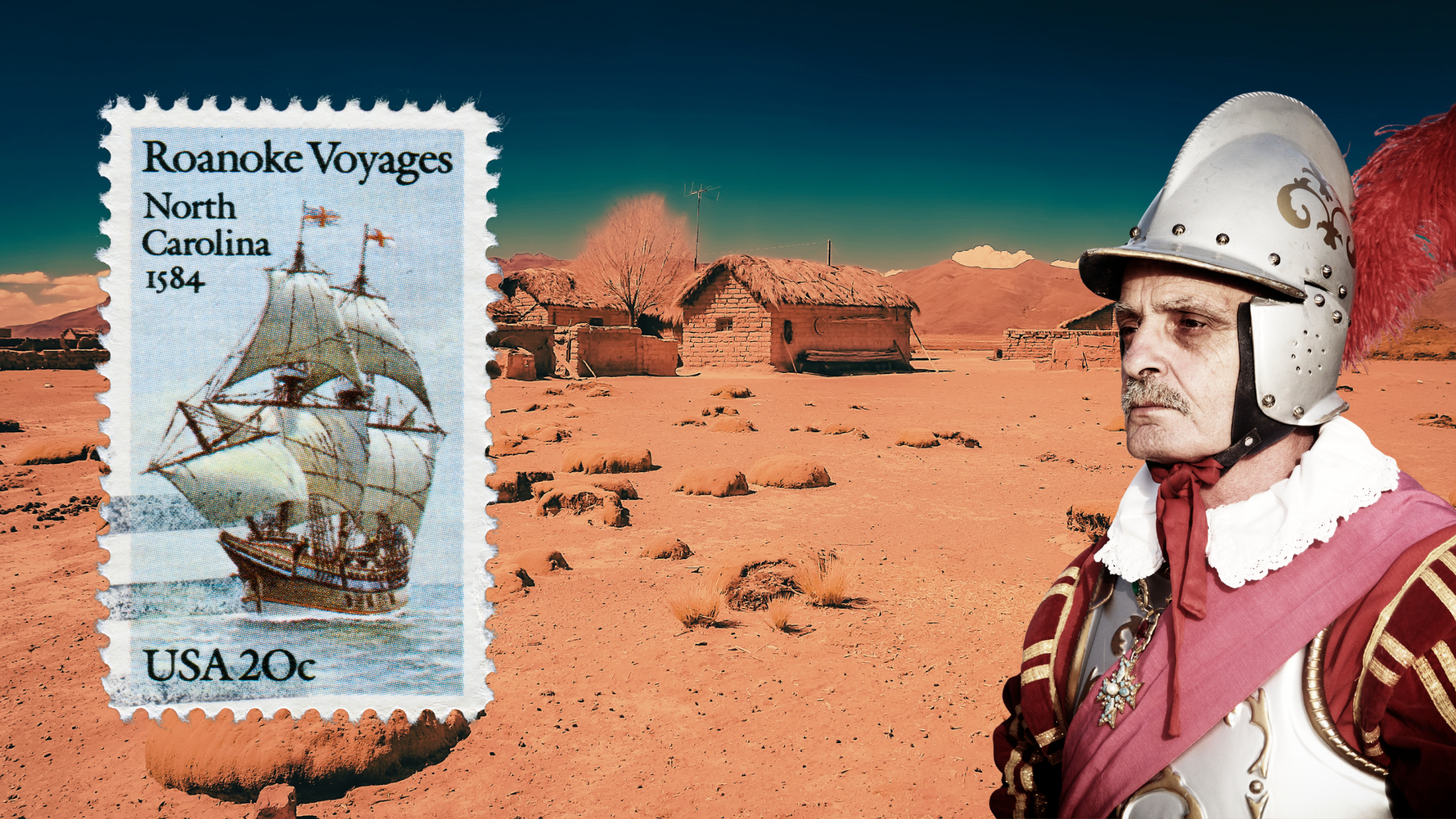
By the 1580s, England was watching Spain grow fabulously wealthy from its American colonies and was determined to stake its own claim. Queen Elizabeth I granted explorer and courtier Sir Walter Raleigh the right to colonize North America, and in 1584 Raleigh sent an expedition to scout the territory. The explorers returned with glowing reports of a land they called Virginia — and two Algonquian men named Manteo and Wanchese, who were brought to London and learned English.
In 1585, the first colonists arrived on Roanoke Island, a strip of land off the coast of present-day North Carolina, in what is now the Outer Banks. That colony failed. Harsh conditions, strained relations with the local Secotan people, and a shortage of supplies led the colonists to abandon the settlement and sail home with Francis Drake in 1586.
Raleigh refused to give up. In 1587, he organized a second, more ambitious expedition — this time of 115 men, women, and children intended as a permanent settlement. Their governor was John White, an artist and mapmaker who had been on the previous voyage. In a sign of how seriously England took this enterprise, White’s own daughter, Eleanor Dare, was among the colonists. On August 18, 1587, Eleanor gave birth to Virginia Dare — the first English child born in the Americas.
In 1930, a memorial was erected to Virginia Dare. Even though what happened to her next is lost in the mists of time.

The Fateful Return Voyage
Almost immediately, the colonists ran into trouble. Their relations with neighboring tribes were uneasy, and their supplies were insufficient. John White was persuaded — reluctantly — to sail back to England to procure more provisions and reinforcements. He left in late 1587 with a promise to return within a few months.
He would not see Roanoke again for three years.
England was at war with Spain. The Spanish Armada threatened invasion, and Queen Elizabeth commandeered all available ships for England’s defense. White was trapped, watching the seasons turn while his family and 114 other souls waited on a remote island across the Atlantic. He finally managed to return to Roanoke in August 1590 — and found the settlement completely empty.
“CROATOAN”
The colonists had not left in panic. The houses had been dismantled, not burned. There were no signs of violence, no bodies, no abandoned belongings scattered in a rush. What White found were two carvings: the letters “CRO” cut into a tree, and the word “CROATOAN” carved in full on a post of the palisade.
Before he left, White had instructed the colonists that if they abandoned the settlement voluntarily, they should carve their destination — and if they were in distress, they should add a cross above it. There was no cross. “CROATOAN” was the name of an island roughly fifty miles to the south (present-day Hatteras Island), home to a friendly tribe led by Manteo, the Algonquian man who had visited England and became England’s ally.
White desperately wanted to sail to Croatoan to search for the colonists, but a storm was approaching, and the ship’s captain refused. The fleet was forced out to sea, eventually heading back to England. White never returned to North America. He died sometime around 1593, never knowing what had become of his daughter, granddaughter, or any of the 114 souls he had left behind.
The Theories
Over the centuries, historians, archaeologists, and amateur sleuths have advanced numerous explanations for what happened to the Roanoke colonists. Here are the most serious:
Assimilation into Native Tribes
The most widely supported theory among modern historians is that the colonists — or at least most of them — integrated into local Native American communities. The carving of “CROATOAN” strongly suggests voluntary movement toward a friendly tribe rather than catastrophe. The lack of violence, the orderly dismantling of structures, and the absence of bodies all point to a planned departure.
Subsequent English expeditions in the early 1600s heard persistent rumors from native people about survivors of a lost colony living among tribes farther inland. John Smith, of Jamestown fame, reportedly heard from Powhatan himself about a group of settlers who had lived for years among southern tribes before being massacred — though historians debate whether Powhatan was describing Roanoke survivors or another group entirely.
The 2012 discovery of a hidden patch on John White’s own 1585 map — revealed under infrared analysis — showed a four-pointed star symbol marking a location inland on the Chowan River. The First Colony Foundation conducted excavations at the site, called Site X, near present-day Merry Hill, North Carolina. They found 16th-century European artifacts, including a fragment of a food-storage jar consistent with types used by the Roanoke colonists. This doesn’t prove survival, but it suggests the colonists moved inland rather than staying put or being annihilated.
Attack by Spanish Forces
Spain viewed English colonization of North America as an existential threat to its own dominance. Spanish ships actively patrolled the Atlantic coast, and there is documented evidence that Spain knew about the Roanoke settlements and sent reconnaissance missions. Some historians argue that Spanish forces found and destroyed the colony — a swift, complete attack that left no trace because the attackers cleaned up after themselves, or because the colonists were taken as prisoners.
This theory is supported by Spanish archives showing serious concern about the English settlement and deliberate efforts to locate it. However, no Spanish record of actually attacking or capturing Roanoke colonists has ever surfaced, and the orderly nature of the abandoned site argues against a violent raid.
Massacre by Hostile Tribes
Relations between English settlers and the indigenous Secotan confederacy had already deteriorated badly during the 1585 expedition. Ralph Lane, the military governor of that earlier colony, had murdered the Secotan chief Wingina — a betrayal that poisoned any chance of peaceful coexistence. It is plausible that the 1587 colonists, left defenseless and dependent on trade with people who had every reason to distrust the English, were attacked and killed.
Against this theory: no remains, no evidence of a massacre, and the cooperative carving of “CROATOAN” suggesting a deliberate, unforced departure.
Starvation and Environmental Collapse
Tree ring studies of ancient baldcypress trees in the Roanoke area reveal that the years 1587–1589 saw the worst drought in 800 years. The colonists arrived in the middle of an environmental catastrophe. Crops would have failed. Game would have been scarce. Even friendly tribes would have struggled to feed extra mouths. This theory doesn’t explain a disappearance on its own, but it powerfully explains why the colonists would have been forced to move — and move quickly.
Attempting to Sail Home
A smaller hypothesis: the colonists tried to build or commandeer a boat and sail back to England themselves, and were lost at sea. A group of desperate people who had been waiting years might well have attempted this. But no wreckage, no bodies on a coastline, and the specific inscription on the palisade make this unlikely as a complete explanation.
Where the Mystery Stands Today
Archaeological work continues. The Croatoan Archaeological Study has been excavating Hatteras Island since 2009 and has found English artifacts including a signet ring and a 16th-century gun fragment. The evidence increasingly points to assimilation — that the colonists dispersed among multiple Native communities and were absorbed into those cultures over time. Not a dramatic end, but perhaps a human one.
The mystery of Roanoke endures not because the answer is unknowable, but because the most likely answer — that 115 English men, women, and children simply became Native Americans — is somehow less satisfying than a proper catastrophe. We want drama. History, more often, gives us quiet dispersal.
Other Colonies That Vanished
Roanoke is the most famous lost colony, but it is not unique. History is dotted with settlements that simply ceased to exist, leaving only ruins and questions.
The Greenland Norse Settlements (c. 985–c. 1408)
For nearly 500 years, Norse settlers maintained two thriving communities on Greenland — the Eastern Settlement and the Western Settlement — established by Erik the Red after his exile from Iceland. At their height, these communities numbered perhaps 5,000 people, with dozens of farms, a cathedral, a bishop’s seat, and regular trade with Europe. Then, over the course of the 14th and early 15th centuries, they quietly vanished.
The Western Settlement was already gone by around 1350. An Icelandic priest named Ívar Bárdsson visited around that time and found only abandoned farms and livestock running wild — cattle, sheep, horses — but not a single human being. The Eastern Settlement held on until sometime in the early 1400s; the last recorded contact was a 1408 document describing a wedding in Hvalsey Church. After that: nothing.
What happened? Here the evidence is actually richer than Roanoke, and historians have converged on a confluence of causes. The Little Ice Age was tightening its grip on the North Atlantic, cooling temperatures, shortening growing seasons, and making sea ice more treacherous. The Norse settlers were stubbornly committed to their European livestock-farming identity — raising cattle and sheep, eating butter and cheese — rather than adopting the marine mammal-hunting diet of the Inuit people (the Thule culture) who were expanding into Greenland at the same time. The Black Death devastated Europe and disrupted trade routes, cutting off Greenland from its economic lifeline. Inuit raids may have added pressure, though the evidence here is disputed.
The Norse settlers appear to have left voluntarily over time — migrating to Iceland or Norway — rather than dying en masse. Recent DNA studies of Norse-origin populations in Iceland show no significant genetic contribution from Greenland, which argues against a large migration. The most likely answer is a slow, grinding decline: emigration of the young and able-bodied, leaving behind an aging population that finally couldn’t sustain itself.
The Aksumite Empire’s Lost Cities (c. 7th–10th centuries)
The Kingdom of Aksum was one of the great civilizations of the ancient world, centered in what is now northern Ethiopia and Eritrea. At its height it controlled trade routes connecting Rome, Persia, India, and sub-Saharan Africa. Its cities were sophisticated urban centers — home to the tallest obelisks of the ancient world, to early Christianity in Africa, to a complex written language and currency system. And then, over several centuries, Aksum contracted, collapsed, and its great city was largely abandoned.
This is less a “colony disappears” story and more a civilization in decline — but the mystery of why Aksum fell so completely is genuine. The leading theory involves a combination of environmental degradation (deforestation, soil exhaustion from centuries of intensive agriculture), the rise of Islam and the resulting shift of Red Sea trade routes away from Christian Aksum, and possibly a catastrophic invasion by a queen named Yodit (or Gudit) in the 10th century. The city was not destroyed all at once — it faded, its population dispersing into the highlands.
The Anasazi/Ancestral Puebloans (c. 1300 CE)
The Ancestral Puebloans — long called the Anasazi, though that name is now considered inappropriate — built one of the most impressive civilizations in pre-Columbian North America, centered in the Four Corners region where modern Utah, Colorado, Arizona, and New Mexico meet. Their great houses at Chaco Canyon held hundreds of rooms and were connected by a sophisticated road network. Their cliff dwellings at Mesa Verde are architectural marvels that still inspire awe.
By 1300 CE, all of it was abandoned. The great houses were empty. The cliff dwellings stood silent. An entire civilization had packed up and left.
Crucially, this is not really a mystery to archaeologists — the Ancestral Puebloans did not disappear. They migrated south and east, and their descendants are the modern Pueblo peoples: the Hopi, Zuni, Acoma, and the Rio Grande Pueblos. They know where they came from. The “mystery” is a colonial projection — the assumption that a civilization sophisticated enough to build Chaco Canyon couldn’t have simply chosen to leave.
The reasons for the migration are well-documented: a prolonged mega-drought in the late 13th century made the Colorado Plateau agriculturally unviable. Tree ring records confirm a catastrophic drought from 1276 to 1299. Combined with evidence of social violence (signs of conflict and possibly cannibalism during extreme resource stress), the migration makes complete sense.
This case is instructive because it shows how “lost colony” narratives sometimes say more about the observer’s assumptions than about the history itself.
Fort St. Louis (La Salle’s Texas Colony, 1685–1689)
In 1685, the French explorer René-Robert Cavelier, Sieur de La Salle, established Fort St. Louis on the Texas coast near Matagorda Bay — a catastrophic navigational error. He had intended to land at the mouth of the Mississippi River to establish a French foothold at the heart of North America, but miscalculated his position by hundreds of miles. He landed instead in territory dominated by the Karankawa tribe, a powerful and hostile people who had no interest in French neighbors.
The colony unraveled swiftly. La Salle’s supply ship sank. Relations with the Karankawa deteriorated into violence. Disease and conflict steadily reduced the colonists’ numbers. La Salle himself was murdered by his own men in 1687 while trying to march overland to Canada for help. When a Spanish expedition finally located Fort St. Louis in 1689, they found it destroyed — the work of a Karankawa attack. A handful of French children had been taken captive and absorbed into the tribe.
This is a lost colony with a known ending — hostile attack, disease, and abandonment — but it illustrates how easily the combination of environmental miscalculation, indigenous resistance, and logistical failure could erase a European settlement completely.
The Franklin Expedition’s Shore Parties (1845–1848)
Strictly speaking, the Franklin Expedition was not a colony, but its disappearance represents one of history’s most thoroughly investigated vanishings and offers important lessons about how communities at the edge of survival unravel.
Sir John Franklin led 129 men aboard HMS Erebus and HMS Terror into the Canadian Arctic in 1845, searching for the Northwest Passage. Both ships became icebound near King William Island. Franklin died in June 1847. In April 1848, the 105 surviving men abandoned ship and began a desperate march south toward the mainland. None of them made it.
Later searches recovered a note in a cairn describing the situation, then Inuit oral histories, then physical remains — scattered bones, abandoned equipment, and eventually, the wrecks of both ships located in 2014 and 2016. The story that emerged was one of scurvy, starvation, lead poisoning (probably from badly soldered food tins), and the final horror of men so desperate they resorted to cannibalism in their last days.
The Franklin case shows what happens when a group loses cohesion under impossible conditions. It also shows — poignantly — how indigenous knowledge that could have saved every one of those men was systematically ignored by the expedition’s officers, who preferred to die as British gentlemen rather than survive as students of Inuit hunters.
What Lost Colonies Have in Common
Looking across these cases, certain patterns emerge.
Environmental stress is almost always a factor. The Roanoke colonists arrived during a record drought. The Greenland Norse faced the Little Ice Age. The Ancestral Puebloans abandoned their cities during a multi-decade drought. Civilizations are more fragile than we like to believe, and climate — then as now — is often the variable that tips a marginal situation into catastrophe.
Failure to adapt to local conditions is lethal. The Greenland Norse refused to hunt marine mammals like the Inuit who survived beside them. The Franklin expedition refused to learn from Arctic peoples who had lived in those conditions for centuries. The Roanoke colonists, dependent on a food supply chain that stretched across an ocean, had no resilience when that chain broke.
“Disappeared” often means “became someone else.” The Roanoke colonists most likely merged with native populations. The Ancestral Puebloans became the modern Pueblo peoples. Colonial disappearances are often not extinctions but transformations — the dissolution of a particular cultural identity into another. We call them “lost” because the identity we were tracking is gone, not the people.
Indigenous relations determined outcomes. Colonies that maintained positive relationships with neighboring indigenous peoples — like the French in parts of Canada, or the Roanoke colonists apparently with the Croatoan — had options. Colonies that poisoned those relationships, through violence, exploitation, or arrogance, lost their margin for error.
The mystery is often manufactured. When a powerful civilization “disappears,” later observers tend to project mystery onto what is actually a comprehensible, if painful, set of human decisions. The Ancestral Puebloans didn’t vanish — they moved. The question “where did they go?” has an answer that the people’s own descendants have always known.
The Enduring Fascination
We are drawn to lost colonies because they trouble our assumption that civilization is durable — that the structures we build, the communities we form, the identities we inhabit, have permanence. They don’t. Every settlement is provisional. Every community survives only as long as its environment, its neighbors, and its own internal coherence permit.
Roanoke endures as a cultural touchstone not because we can’t imagine what happened — historians increasingly can — but because the image of 115 people simply gone, their fate absorbed into a land that didn’t need them, is genuinely haunting. Virginia Dare, the first English child born in America, grew up — if she grew up at all — not as an English girl, but as someone entirely different. The first American-born English person became, in the most literal sense, a Native American.
There is something in that transformation that resists easy resolution. Not because it’s unknowable. But because knowing it requires us to let go of the story we wanted.
Further reading: David Beers Quinn’s Set Fair for Roanoke (1985) remains the definitive scholarly account of the Roanoke expeditions. For Greenland, Jared Diamond’s chapter in Collapse (2005) is compelling, though its “ecocide” framing has been updated by later scholarship. Andrew Fagan’s The Little Ice Age (2000) provides essential environmental context for several of these cases.
NOTE ON THE AUTHOR:
Tony McMahon is an investigative historian often see on TV: https://tony-mcmahon.com/
He is the author of several books on different historical topics including the Knights Templar: https://www.pen-and-sword.co.uk/The-Knights-Templar-Hardback/p/51654
Tony is the co-host of the Talking Templars podcast on YouTube and other channels.