


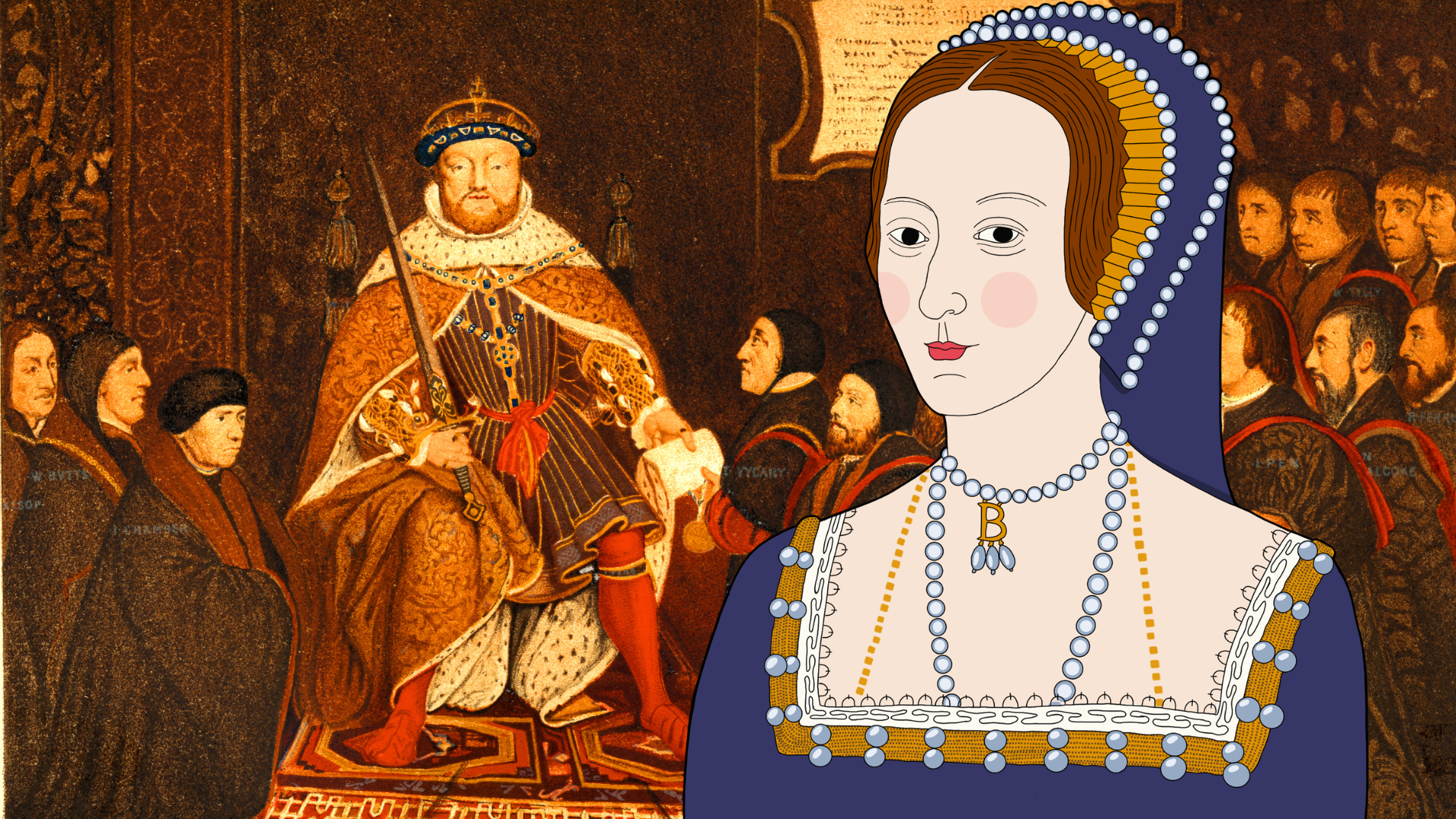
Henry VIII is one of history’s most recognisable monarchs — not for his military genius or philosophical writings, but largely because he went through wives at a rate that would give a modern divorce lawyer palpitations. Six marriages, two beheadings, two divorces, one death in childbirth, and one queen who had the good sense to outlast him. It’s less a royal court and more a cautionary tale.
By the way – I once dressed as Henry VIII for an appearance on ITV’s The Big Audition – voice over is Julie Walters.
The Six, in Order of Appearance
Catherine of Aragon was Henry’s first wife and, by most accounts, the one he actually loved — at least for a while. Spanish, dignified, and deeply devout, she was originally married to Henry’s brother Arthur, who died conveniently young. Catherine and Henry were married for over twenty years and she bore him six children, though only one — Mary — survived infancy. When Henry decided he needed a male heir and had spotted Anne Boleyn across the banqueting hall, Catherine refused to go quietly. She contested the annulment to her dying breath, insisting she was Henry’s lawful wife. She was right, of course, but being right rarely helped anyone in Tudor England.
Anne Boleyn was the woman for whom Henry upended the English Church, broke with Rome, and invented the Church of England — which is either a testament to her remarkable personal magnetism or a sign that Henry was catastrophically bad at handling rejection. Anne was sharp, ambitious, and politically astute, but she made enemies easily and, crucially, also failed to produce a male heir. She gave Henry Elizabeth — later Elizabeth I, one of England’s greatest monarchs — but Henry had already moved on emotionally. Anne was arrested on charges of adultery and treason in 1536, almost certainly fabricated, and was beheaded on Tower Green. She was 35.
FIND OUT MORE: Why Henry VIII had no friends
Jane Seymour was the quiet one, and Henry seemed to genuinely adore her — possibly because she didn’t argue with him. She gave him his longed-for son, Edward, in 1537, then died of postnatal complications shortly after. Henry wore black for months and was buried beside her at Windsor upon his own death. In the brutal arithmetic of Tudor marriage, Jane played the game perfectly: give him a son, then exit before he gets bored.
Anne of Cleves arrived in England in 1540 as a diplomatic match, chosen partly on the basis of a flattering portrait by Hans Holbein. When Henry met her in person, he reportedly found her so unappealing he called her “a great Flanders mare.” Anne, to her enormous credit, agreed to an annulment without fuss, accepted a generous settlement, and spent the rest of her life in comfortable English estates, outliving Henry and all the other wives. She is, objectively, the winner.
DISCOVER: How Anne of Cleves kept her head
Catherine Howard was Henry’s fifth wife and his most tragic. Young, vivacious, and probably no more than seventeen when she married the by-then obese and ill-tempered king, she appears to have conducted a relationship with a courtier, Thomas Culpeper — ill-advised at the best of times, suicidal in Tudor England. She was beheaded in 1542 at an age when most young women today would be stressing over A-levels.
DISCOVER: Henry VIII’s health report – obese and impotent
Catherine Parr was Henry’s last wife and his most intellectually matched. Twice-widowed, scholarly, and politically shrewd, she managed Henry’s declining years with skill, helped reconcile him with his daughters Mary and Elizabeth, and survived. She outlived Henry by a year, which, given the odds, deserves some kind of prize.
Was Any of This Normal?
By sixteenth-century standards, multiple marriages were not unusual — death in childbirth and disease made remarriage common. What was unusual was executing a queen. Monarchs occasionally imprisoned inconvenient wives or sought annulments, but beheading them was another matter entirely. Even by the standards of the age, it shocked European courts. Francis I of France and Charles V of Spain watched Henry’s matrimonial adventures with a mixture of horror and disbelief. Putting a crowned queen on trial for treason and cutting her head off was not, to put it diplomatically, standard procedure.
And the Winner Is?
If we’re asking which wife best understood how to handle Henry VIII, the answer is Anne of Cleves — not through love or politics or producing heirs, but through the simplest strategy available: immediate, cheerful compliance. She wanted no part of the fight, accepted reality, took the money, and lived happily ever after in the English countryside.
In a court where ambition, devotion, and even love proved fatal, Anne of Cleves had the wisdom to simply… leave. Sometimes the smartest thing you can do with a dangerous man is agree with everything he says and make sure you’re somewhere else.
A couple of years ago, I gave a talk on Hampton Court Palace – where Henry VIII resided part of the time, having seized it from Cardinal Wolsey. You may not know that Hampton Court was originally a Knight Hospitaller estate. Find out more in this video!
And my visit to Hampton Court Palace in 2022 – a full guided tour – including where Bridgerton was filmed!
NOTE ON THE AUTHOR:
Tony McMahon is an investigative historian often see on TV: https://tony-mcmahon.com/
He is the author of several books on different historical topics including the Knights Templar: https://www.pen-and-sword.co.uk/The-Knights-Templar-Hardback/p/51654
Tony is the co-host of the Talking Templars podcast on YouTube and other channels.


