It’s the year 1936. A king who is about to be crowned abdicates. Officially it’s because he’s having a steamy affair with an American divorcee that scandalises the British establishment. Unofficially it’s widely known in elite circles that this American and the new king have Nazi sympathies. When he does relinquish the throne, British fascists converge outside the Prime Minister’s residence demanding that the abdicating king be crowned. Meanwhile, one group of MPs sees the opportunity to declare a British Republic.
The last great royal scandal before Andrew Mountbatten-Windsor
The last royal scandal to come close to matching the Andrew Mountbatten-Windsor debacle was the abdication of King Edward VIII in 1936 – when the monarch decided to give up the throne. All for the love of an American divorcee, Wallis Simpson, was Edward’s official excuse. As the government introduced the legislation to facilitate the abdication, one group of MPs called for the abolition of the monarchy and the declaration of a British Republic.
If these members of parliament had got their way, the reigns of King George VI (1936-1952) and Queen Elizabeth II (1953-2022) would never have happened. Would we have been better off if the House of Windsor had been brought to an end in the 1930s? We might have avoided the tragedy around Princess Diana and the current scandal engulfing ex-Prince Andrew.
First let’s recap on the walking disaster that was King Edward VIII.
King Edward VIII takes the throne….and then doesn’t
January 1936 saw the death of King George V who had reigned since 1910. His doctor later admitted to injecting a fatal dose of morphine and cocaine in to the king’s jugular vein to hasten his demise. His oldest son, Edward Prince of Wales, had been groomed for the top job for years but had proven to be a problematic character.
He saw himself, like other royals gone rogue in more recent times, as a non-conformist who rejected the stuffiness of the monarchy and possessed some kind of special connection to the people. Critics viewed him as a superficial, vain character who put personal pleasure above duty.
His penchant for married women led him into an affair with an American divorcee, Wallis Simpson. The government was concerned that Edward and Wallis had developed Nazi sympathies. Simpson was reported to have enjoyed an amorous liaison with the leading Nazi diplomat – and later UK ambassador – Joachim von Ribbentrop, before jumping into bed with Edward.
Meanwhile wealthy fascist socialite Dame Fanny Lucy Houston urged Edward to become a royal dictator and usher in fascism. When Edward abdicated the throne in December 1936, Houston was so horrified that she took to her bed and refused to eat, dying of a heart attack before the year end.
By December 1936, Edward’s relationship with Wallis Simpson was so unacceptable to the British establishment that he threw in the towel, abdicating in favour of his brother, who would become George VI. Though Simpson was often cited as the main reason for quitting the throne, his fascist leanings were also worrying leading political figures.
Fascists demand Edward VIII be crowned
Views were polarised about Edward’s stepping down. The British Union of Fascists, led by Oswald Mosley, held a 2,000 strong demonstration outside the Prime Minister’s residence in London shouting “We want Edward!”. They referred to him as a “Workers’ King”, an image he had cultivated by visiting industrial areas affecting concern for miners and factory employees.

MPs call for a British Republic
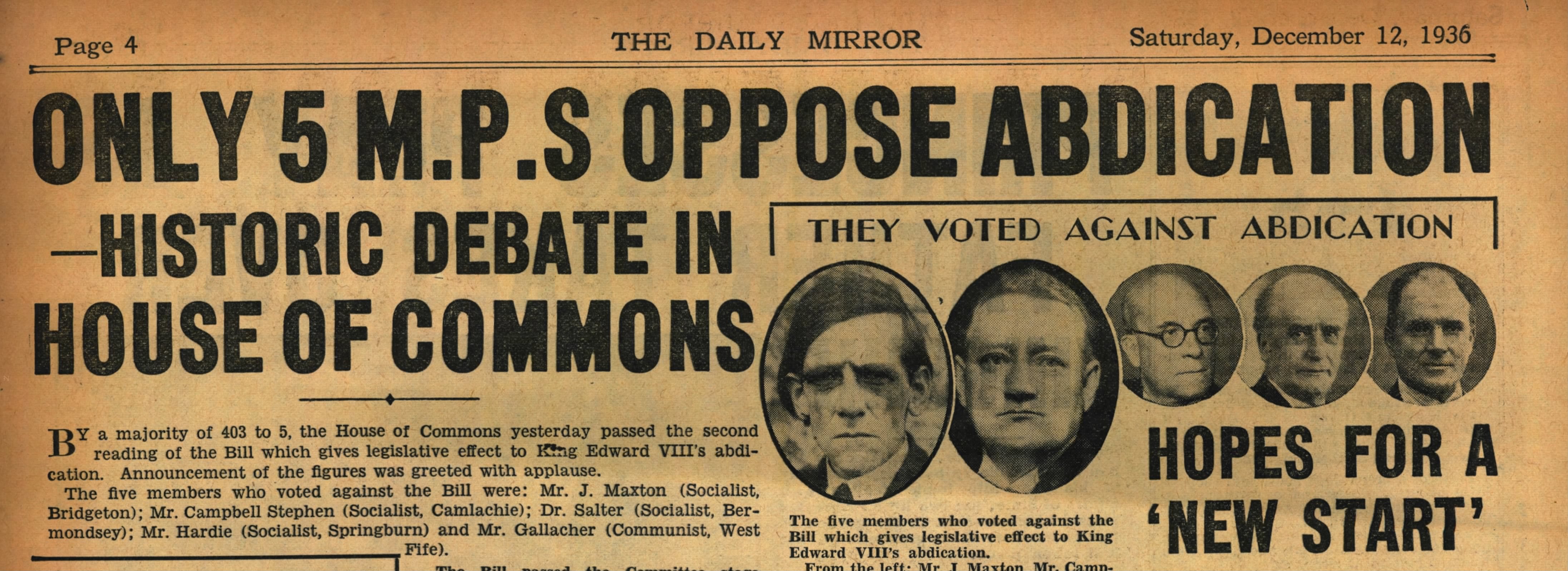
On 11 December 1936, the Conservative party Prime Minister Stanley Baldwin brought the Abdication Bill before parliament, allowing for Edward to be replaced by his brother George. But the radical socialist MP James Maxton then introduced a republican amendment to the bill demanding that the country ditch an outdated institution and become a republic. He was backed by four other MPs: Campbell Stephen, Dr Alfred Salter, Agnes Hardie, and Willie Gallacher. Four of the MPs were left-wing Labour while Gallacher was a Communist.
Maxton spoke in parliament on “the danger to this country and to the British Commonwealth of Nations inherent in an hereditary monarchy at a time when the peace and prosperity of the people require a more stable and efficient form of government of a republican kind in closer contact and more responsive to the will of the mass of the people”.
The republican amendment was discussed and reported at surprising length. However, it was overwhelmingly defeated and the monarch soldiered on to the present day.