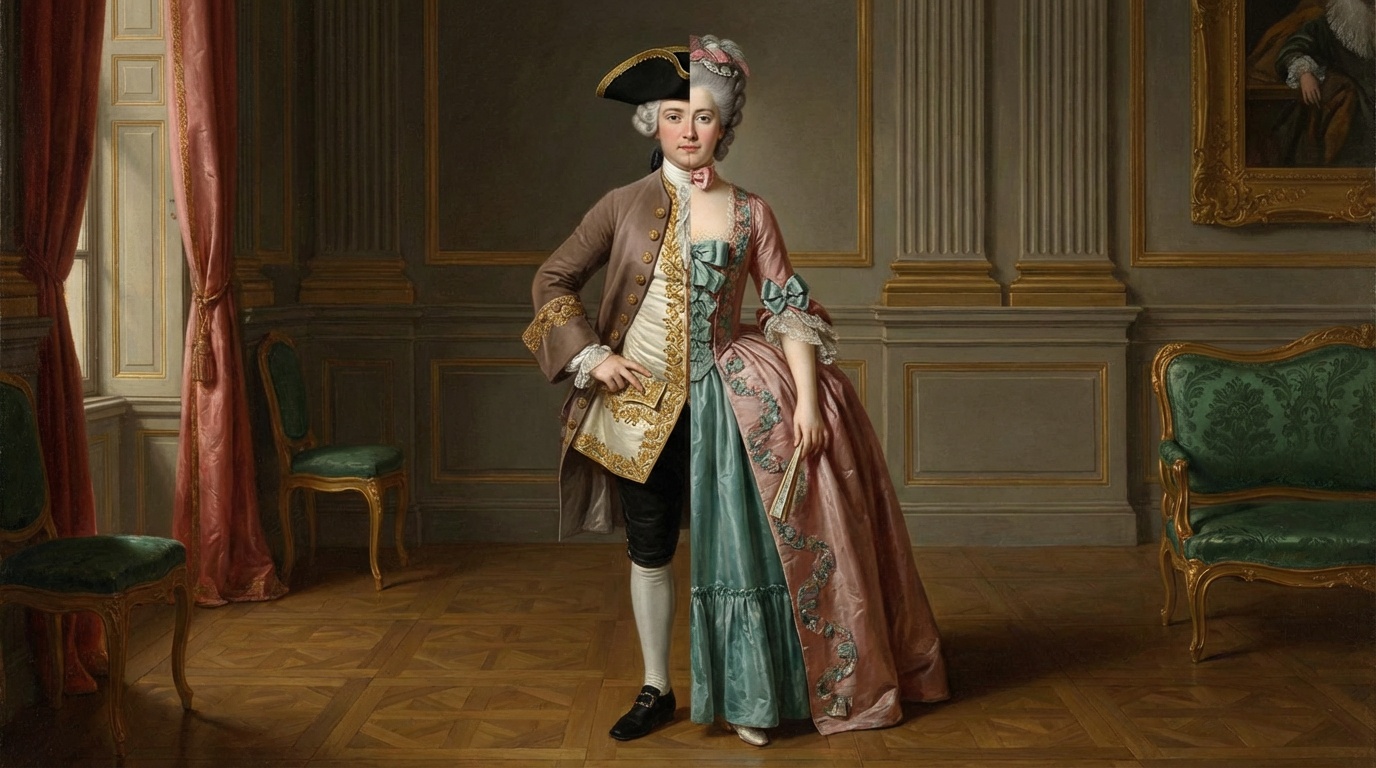
In today’s toxic political climate, intersex and non-binary people have been weaponised in a cynical so-called “culture war” over gender. Non-binary is dismissed as a new-fangled concept dreamed up in university ivory towers. But browse through 18th century newspapers and court records, and stories about “hermaphrodites” leap off the pages. Complex sexual identities are as old as humanity.
Let’s look at some fascinating insights from nearly 300 years ago that reveal a surprising level of awareness of gender and sexuality.

Bigamy case collapses
In September 1719, Katherine Jones was indicted at the Old Bailey (central criminal court) in London on a charge of bigamy. Katherine had married John Nowland in April 1713. Five years later, without the knowledge of the still very much alive Nowland, she married Constantine Boone. So, she had committed the crime of bigamy – a serious offence in 18th century England.
But Katherine had an intriguing defence. Her second husband “was no man, and therefore could not be a husband, that it was a monster, a hermaphrodite”. Constantine had apparently been exhibited as such at Southwark Fair “and several other places”. Treated then as a circus curiosity at a notoriously raucous annual fair in the middle of London. Katherine continued that husband number two had been brought up as a girl, even practising needlework, and only turned male on joining the navy.
Constantine appeared in court, admitting to being a hermaphrodite. The court report stated: “It appearing by her own confession as well as other evidences that the woman was more predominant in her than the man, the prisoner was acquitted”. Katherine walked out of court on the strength of an intersex defence.
Another case at the Old Bailey in 1767 saw Mary Tom House accused of stealing a linen shirt, a pair of silk stockings, and a linen apron. The case summary made the point that Mary also had the name Tom as “this prisoner was a hermaphrodite”. Things didn’t go well for Mary who was sentenced to transportation to the colonies for 7 years.
DISCOVER: American GI changes sex in the 1950s
Husband and wife at loggerheads
In 1771, a very unusual legal case was referred to the Doctor’s Commons – a court in London specialising in “wills, wives, and wrecks”. Or put another way, cases involving probate, divorces, and maritime law. A wealthy squire in the county of Surrey was accusing his forthright wife of “incontinency”, a word which at that time combined infidelity with wantonness.
She wasn’t going to take that from her husband and countered that he was a hermaphrodite. The outcome of the case is lost to history. Two years later, I found a case in the same newspaper, before the Ecclesiastical Court, of a “gentleman of fortune” accusing his wife of being a hermaphrodite.

FIND OUT MORE: An 18th century transgender couple
Intersex prisoner
In 1760, in the city of Bristol, a person called Montague was committed to the “house of correction”, a form of prison that emphasised hard labour, on charges of being “disorderly and an impostor”. A local newspaper reported that Montague “feigned himself a woman, in man’s apparel; imitated a female voice, which joined to his effeminate look, served to carry on the imposture”.
Montague looked for sympathy from locals, in the form of financial assistance, by threatening to “poison himself” or committing suicide by hanging. Eventually the authorities ruled that Montague was a confidence trickster, swindling kind people out of their money by false pretences. However, the questioned remained – was Montague male or female?
An “examining apothecary” carried out an examination on Montague and declared female. A surgeon who was also present agreed. However, another surgeon investigated further and concluded Montague was a hermaphrodite. But then, a nurse at a local hospital opted for male. How, you may wonder, could anybody get it wrong?
Rather cruelly, the newspaper hoped that Montague would now be whipped in the prison – and that would somehow sort everything out.

DISCOVER: LGBT people arrested in 19th century London
Preventing medical examination in death
In 1784, the Hartford Courant, a newspaper in the newly independent United States, reported on the tragic death of a “noted hermaphrodite”, found by the side of fence. Their occupation had been a “bellows-mender”.
“The uncommon shrillness of his voice so much attracted the attention of the late Dr Hunter, that he was induced to doubt his sex; and having interrogated this person on the occasion, he declared to the Doctor his deficiency of claim to either sex.”
In a gesture that was macabre, generous, and exploitative all at the same time, the doctor paid the un-named person a five shilling weekly allowance, on top of whatever was earned from mending bellows, on condition that the doctor could claim the hermaphrodite’s body after death. However, the doctor passed away.
The bellows mender had a change of heart about being operated on after death. This was a time when anatomists were taking bodies from the gallows to cut open in front of gawping medical students – and paying onlookers. Poor families dreaded their loved ones ending up on the anatomy table.
So, the bellows mender resolved to frustrate the ghoulish desires of any doctors by dying in a remote place. The idea being that the body would have rotted to the point where it was of no use to the anatomists. What an insight into this period of history!

A bizarre poem
In 1772, a newspaper warned its readers of the perils of succumbing to the charms of the so-called “hermaphrodite”:
Take Heed, ye Fair, in this licentious Age
Lest Demi-Men your easy Hearts engage;
And sure it poorly would your Loves requite
To wedded be with an Hermaphrodite
At that time, the hermaphrodite exciting high society was the French diplomat, the Chevalier d’Eon who switched from male to female attire, according to whichever city the chevalier was based in. Bets were placed on whether D’Eon was male or female.
An autopsy in 1810 found male organs but also “unusual roundness in the formation of limbs” and “breast remarkably full”. Modern scholars have interpreted these findings as proof of D’eon being intersex or transgender.
FIND OUT MORE: Chevalier D’Eon the transgender 18th century celebrity
“Pritty fellow” or “Macaroni”
Challenging gender conformity in 1770 were two types of chap that one newspaper found despicable. First, there was the “Pritty Fellow”.
“A Pritty Fellow is a thing that dresses in the bon-ton, so as to appear different from all mankind, and the more ridiculous, the more like a Pritty Fellow … if he knows the best perfume shop, and the most janty milleners, and can harangue on the virtue of milk of roses, almond paste, the sweetest perfumed garters, chicken-skin gloves, and violet powder, he is a complete Pritty Fellow”.
The Pritty Fellow was “a creature of the amphibious, heterogenous kind, in some respects it is an hermaphrodite, a compound of Mercury and Venus, of both sexes, and yet neither, it is a trival thing, and truly of the doubtful gender.”
Noteworthy that the Pritty Fellow is constantly referred to as “it”. Ladies, the newspaper observed, kept such “creatures” about them to flatter her or exchange mindless pleasantries. The description could cover more than one identity but effeminate gay men is an obvious category. And the fact that women enjoyed their company was clearly something the reporter couldn’t stomach.
The Macaroni was “another new sect” in 1770 with a garish hairstyle, or wig, green stockings, and a Chinese-style waistcoat. The impression given by this reporter is that their relationship with women was more flirtatious, even “impertinent”. Society ladies, in turn, used them like a “toothpick”.
Although some modern commentators believe most Macaronis in the 18th century were gay men, this contemporary reporter seems to be describing non-binary men of any sexual preference. The average Macaroni seemed to work mainly in retail: “You can’t go into a mercer’s, a draper’s, or a haberdasher’s shop, but you see a monkey behind the counter, with such a load of hair to his head, that a porter would not carry it in the dog days from Cheapside to St James’s Street for a couple of shillings”.

Fashion designers
In 1787, one fashion writer remarked on that year’s dresses. What a shame that they were not corresponding more closely to the “natural shape” of women. One had to wonder whether “hermaphrodites have introduced certain fashions for the sole purpose of concealing their own defects and deformities”. The level of paranoia and fear about intersex people matches today’s political furore about trans people.
In the armed forces – army and navy – women dressing as men to bear arms was reported on many occasions. Here is a story below from 1739.

NOTE ON THE AUTHOR:
Tony McMahon is an investigative historian often see on TV: https://tony-mcmahon.com/
He is the author of several books on different historical topics including the Knights Templar: https://www.pen-and-sword.co.uk/The-Knights-Templar-Hardback/p/51654
Tony is the co-host of the Talking Templars podcast on YouTube and other channels.