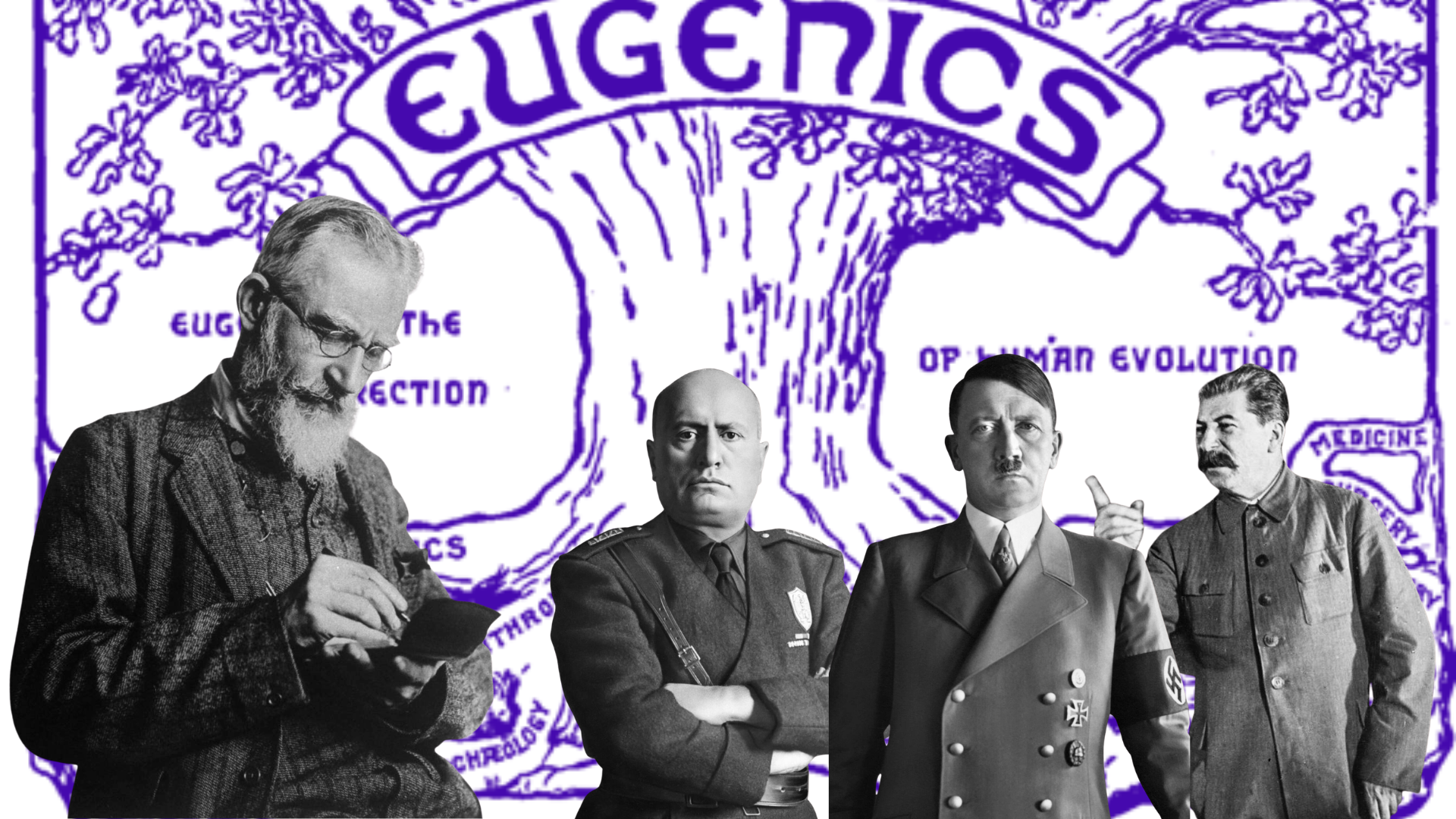
Why are we still teaching the works of Irish playwright George Bernard Shaw (1856-1950) in schools? This monster joined the eugenics movement in the early 20th century advocating – in no uncertain terms – the mass killing in “lethal chambers” of people who were not useful to society. Not surprisingly, he then became a cheerleader for Stalin, Hitler, and Mussolini – all the 20th century’s worst dictators. Far from being unaware of the murders and violence they perpetrated, he sought to justify them – very explicitly. Let me try and convince you then why Shaw should be banned in schools.
Shaw casts a shadow over our school curriculums
Shaw has been a staple of English exams for nearly a century. He still features in the GCSE syllabus. Back in the early 1980s, I studied Shaw’s plays for ‘A’ Level English. Shaw called himself a socialist but was the kind of Fabian intellectual who despised working-class people, preferring society to be run by elite technocrats. Worse, he advocated for literally eliminating human beings who didn’t meet high enough standards.
In 1931, the 75-year-old Shaw visited the Soviet Union, already under the iron grip of Joseph Stalin. The country was in the middle of a famine and Stalin was set on murdering his old party comrades in a series of purges. Stalin’s main rival, Leon Trotsky, had been exiled two years previous. Previously, I thought Shaw was blind to all of this and slightly naïve – a useful idiot for Stalin.
He returned to Britain singing Stalin’s praises and condemning criticism as propaganda. When I first saw footage of Shaw being feted in Moscow, I thought he was a harmless old dupe. But I now realise that Shaw was not averse to a bit of violence, even murder, if it led to his idea of progress.
Shaw was a relentlessly self-promoting celebrity who lived a long life. His famous plays include Pygmalion (1912) adapted as the movie My Fair Lady and Saint Joan, telling the story of the French martyr. He has the rare distinction, shared only with Bob Dylan, of having won both an Oscar and the Nobel prize (for literature). As a socialist, Shaw joined the Fabian Society advocating a reformist approach, as opposed to a Marxist revolution. He championed women’s writes and believed the theatrical stage should be a place to discuss complex political ideas.
So far, so good. But it’s all downhill from here…
Bernard Shaw advocates mass killings
Shaw supported eugenics, a thoroughly discredited pseudo-science claiming that the quality of humanity could be improved by preventing “inferior” people from reproducing while encouraging those with “superior” traits. To achieve this, eugenicists advocated sterilisation and, in some cases, murder. In a speech to fellow supporters of eugenics in 1910, Shaw said this:
“A part of eugenic politics would finally land us in an extensive use of the lethal chamber. A great many people would have to be put out of existence simply because it wastes other people’s time to look after them.”
The use of lethal chambers to get rid of the undesirable was mixed with more mainstream socialist policies of the time like the abolition of private property and marriage. In fact, his views on marriage attracted more attention that his call for the killing of less worthy citizens.
Shaw argued that it was a waste of society’s time looking after those who could not fend for themselves. His use of the term “lethal chamber” is chilling, given that two decades later, Hitler would mechanise the mass murder of Jews, and others, with the gas chambers. But as we’ll see, Shaw had no qualms about political dissidents being killed by dictators he admired.

DISCOVER: The Nazis who fled to Egypt
Bernard Shaw praises Mussolini
Shaw was no great fan of democracy. Some of his observations on liberal, mainstream politicians would find support today among those seduced by populism. His hatred of the democratic process led him to sympathise with dictators like Stalin, Hitler, and Mussolini.
The latter dictator took power in Italy in 1924 after marching on Rome with his blackshirt thugs. Mussolini viewed violence as a cleansing act, removing his opponents with clubs, knives, and pistols. His thuggery wasn’t hidden or unknown when, in 1927, Shaw wrote a letter to an Italian newspaper praising the Italian fascist dictator as a selfless hero who should ignore criticism from Italian socialists.
He dismissed the torture, by Mussolini’s paramilitary blackshirts, of the regime’s opponents, forcing individuals to drink pints of castor oil in public forcing them to defecate uncontrollably. Shaw added that damning fascism because of the murder of Giacomo Matteoti, the socialist leader, by fascist blackshirts, was like condemning feudalism purely on the strength of the murder of Thomas Becket, Archbishop of Canterbury, by King Henry II.
It’s a weak analogy and a disgraceful dimissal of a cold-blooded killing of a democratic politician bundled into a car and summarily executed. But to Shaw – it was all excusable for the greater good.

DISCOVER: Depicting the Nazis as a gay cabal
Bernard Shaw backs Stalin on the purges
In the 1930s, the Soviet dictator, Joseph Stalin, embarked on his infamous purges with the most intense period of show trials and executions being between 1936 and 1938. The old leadership of the Bolsheviks, who had led the 1917 Russian Revolution alongside Stalin, were “liquidated”, to use the parlance of the time.
Communists around the world, loyal to Moscow, echoed Stalin’s claims of “counter-revolutionary” threats to the communist state, especially from supporters of Leon Trotsky, who would himself be assassinated in Mexico City in 1940. In Britain, the Daily Worker ran the appalling headline: Shoot the Reptiles!
Shaw had no problems with this, declaring that the veteran revolutionaries who displeased Stalin “often have to be pushed off the ladder with a rope around their necks”. Some have tried to downplay Shaw’s comments as verbal fireworks or attention seeking. But set alongside his fervent support for eugenics, and “weeding the garden”, has he once described the removal of “undesirables”, it’s not hard to see how Stalin’s purges might have thrilled the old buzzard.
Bernard Shaw admires Hitler
Shaw’s admiration for Hitler is the greatest shock about this playwright. How could a socialist have a soft spot for the Nazi dictator? Although he didn’t fully endorse Nazi race ideology, Shaw’s eugenics chimed with much of the Third Reich’s ideology and practice. In his play, Man and Superman, Shaw had also extolled the virtues of heroic figures who rise above everyday mundane mediocrity.
Shaw was influenced by the philosophy of Friedrich Nietzche (1844-1900) and I find Shaw similar in may ways to the Russian-American right-wing ideologue, Ayn Rand (1905-1982). Both bought into the Nietzchian idea of the Übermensch (superman). Shaw came at the concept from a technocratic and eugenicist perspective while Rand believed in an unfettered capitalism, coupled with unrestrained selfishness.
When it came to Hitler, Shaw described the Fuhrer’s biographical manifesto, Mein Kampf, as a “bible” and sympathised with the grievances being raised, such as the terms of the Versailles Treaty imposed on Germany at the end of World War One. Hitler promoted a stabbed-in-the-back idea about the treaty, blaming Jews and Marxists for allowing Germany to surrender in 1918. This was undeniably effective propaganda but also a cynical, fact-free rewrite of history.
Nevertheless, Shaw described Hitler as a “very remarkable, very able man”. And throughout the 1930s spoke glowingly about the rapid rise to power of the Nazi leader and his dispensing with parliamentary, democratic structures. In 1933, Shaw addressed a Fabian conference with these words:
“…the annoyed expression that one always sees on Hitler’s face is a sign of intense resentment […], more than justified. Our statesmen seem, on the other hand, too smug, too comfortable about things that should make them seethe with anger. Wouldn’t you all be Nazis in England if such an unjust treaty as the Treaty of Versailles had been imposed on you by foreign powers?”
While Shaw was condemned by the Nazis, alongside other socialist artists, most of his works were not banned during Hitler’s rule in Germany between 1933 and 1945. However, Shaw did become disenchanted with Hitler over his treatment of the Jews, though even that was expressed in terms of eugenics.
At the same 1933 lecture, Shaw took issue with Hitler over his approach to the Jews only because the playwright thought the Fuhrer should be enforcing intermarriage between German Jews and non-Jews to prevent inbreeding and encourage mass fertilisation.
“He should have said, ‘I will tolerate Jews to any extent as long as no Jew marries a Jewess.’ That is how he could build up a strong, solid German people.”
In other words, Shaw was engaging with race ideology, just differing with Hitler on implementation.

Opposition to vaccinations – even smallpox
Finally, we have Bernard Shaw sounding forth on vaccination, which he described as “a peculiarly filthy piece of witchcraft”. Shaw was born in 1856 and vaccinated in infancy. He contracted smallpox during the epidemic of 1881 which convinced him that vaccinating children was “an unscientific abomination and should be made a criminal practice”.
Shaw didn’t live long enough to see vaccination programmes eliminate smallpox completely in 1980. Five decades before, in 1929, Shaw was ranting against childhood inoculations. “You let a doctor take a dainty, helpless baby and put that stuff from a cow, which has been scratched and had dirt rubbed into her wound, into that child.”
There were issues with hygiene in the early 20th century with at least one incident of children contracting tetanus from injections yet those who went without immunisation, succumbed to smallpox. But once the issue of hygiene was addressed with better regulation, that risk was removed.

So, do you agree? Is it time to relegate George Bernard Shaw to the dustbin of history and have his works banned in our schools?