


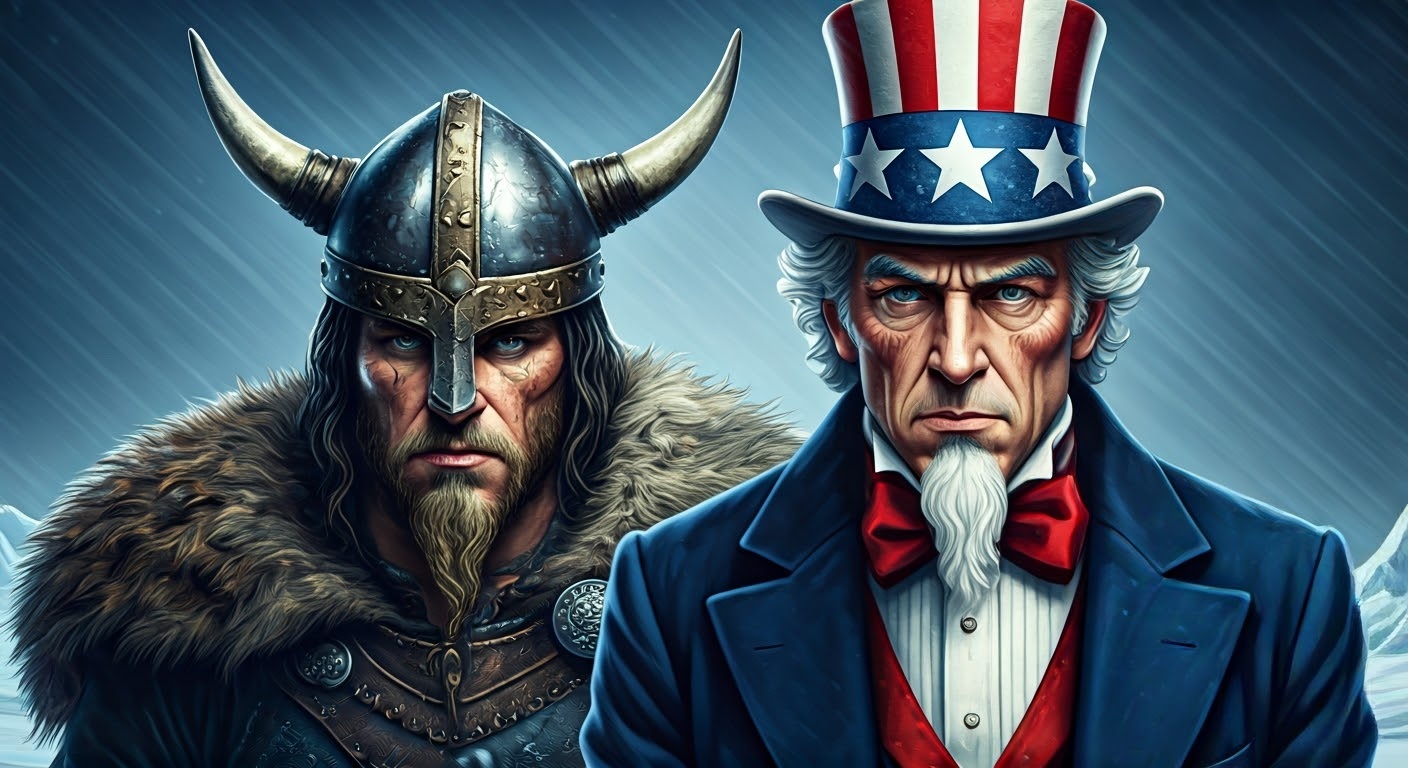
United States President Donald Trump has declared he wants to buy Greenland from Denmark. The Danes have responded very tersely that the large icy landmass off the coast of Canada is not for sale. However, American claims on Greenland are not new. In the early twentieth century, both Denmark and Canada went into panic mode as the US eyed up the territory.
America bought bits of Denmark before
From 1672, Denmark not only owned Greenland but also governed several islands in the Caribbean. Throughout the nineteenth century, the United States was expanding in all directions and Congress began to take a keen interest in these Danish holdings.
In 1916, during the First World War, Denmark agreed to the sale of the Danish West Indies to the United States for $25 million in gold bullion. American political leaders argued that ownership of these islands in the Caribbean was essential to the defence of the Panama canal – to stop it falling into enemy hands. Germany was seen as the main threat.
There had been an abortive attempt by the US to buy the Danish West Indies in 1867 at a much lower price but this fell through when the US Senate refused to ratify the sale. There was another attempt in 1902, which also stalled. So, when the Americans returned to the negotiating table in 1916, Denmark demanded a much higher price.
Why did Denmark sell?
There were several reasons for why Denmark decided to part company with its Caribbean colony. Not least that in 1898 the United States had invaded neighbouring Puerto Rico and Cuba, ending four hundred years of Spanish rule. That certainly concentrated minds. But so did the attitude of the people on the islands.
The majority of the population of the Danish West Indies were freed slaves of African heritage who became more militant in defence of their living standards on the island plantations growing sugar and tobacco. This resulted in a wave of protest in the years leading up to the sale, exhausting Denmark’s resolve to retain the faraway islands. These struggles continued under American rule, led by the black activist David Hamilton Jackson (1884-1946).
Despite considerable opposition among the Danish public, Denmark agreed to the sale in 1916. But the Danes inserted a very telling clause into the handover treaty. They insisted that the United States drop all territorial claims to Greenland.

Greenland in American sights
What is fascinating about this incident is that the question of American control over both the Panama Canal and Greenland was linked so closely to the sale of the Danish West Indies. Underlying this was a clash between the old world and the new world. The United States was enforcing the 1823 Monroe Doctrine that sought to remove all European colonialism in the western hemisphere. President Trump seems to have revived this doctrine with renewed gusto.
Some Americans in 1916 began taking a close look at Greenland and questioning Danish control. Their argument was that Denmark’s small presence at the southernmost tip of Greenland did not entitle it to the entire land mass. And most of the people living in the south were Inuit – not Danes. One American newspaper estimated the population at just twelve thousand covering one-twenty-fifth of Greenland’s total surface area.
These American commentators stated that if an area of the Americas was uninhabited, then the United States had every right to stake a claim. In 1892, American explorer Robert Edwin Peary (1856-1920) led an expedition to northern Greenland and managed to prove, for the first time, that it was an island. He also named a peninsula in the Arctic after himself – Peary Land – and it still bears that name.
He returned in 1898 for a much longer expedition, hoping to reach the North Pole. He failed in 1902 but his team got there subsequently – metaphorically or literally planting the Stars and Stripes at the top of Greenland. With news of the expedition’s progress all over the newspapers, the future of Greenland became a lively point of discussion in American, Canadian, and Danish newspapers.

DISCOVER: What if Russia invaded Alaska?
Some in Denmark consider selling Greenland
As early as 1902, the Danish newspaper Politiken floated the idea that both the Danish West Indies and Greenland should be sold to the United States. The ruling political party in Copenhagen – Venstre Reform – was a centre-right force advocating economic liberalism. It was cash strapped and keen not to raise taxes so some figures close to the Danish government wondered out loud whether a big sell-off would solve their economic problems. Denmark’s Prime Minister, Johan Henrik Deuntzer (1845-1918), even declared in a speech in 1902 that colonies were a “luxury of the big powers”.
This sparked panic in Canada. A flurry of telegrams sped across the Atlantic to the Danes telling them to drop the idea while at the same time, Canada began planting Union Jacks all over the Arctic islands to the west of Greenland. The Union Jack was only supplanted by the Maple Leaf flag in 1965. Any attempt at American expansion into the polar wastes was to be resisted. Canada did not want to be surrounded on all sides by the United States.
However, there was a little bit of hypocrisy in all of this because the Canadians also coveted Greenland. In 1903, The Cleveland Leader reported that Canada was up for making a bid for Greenland and uniting it with Newfoundland. In Ottowa, there was still a great of unhappiness about the border demarcation agreed with the United States between Alaska and Canada – which was seen to have favoured the Americans. Maybe they could make up for land lost in the west to America by grabbing something off the Danes to the east.

Rumours that Canada wanted to buy Greenland continued after the United States lost interest. In 1930, the Star Weekly newspaper stated that there was a romantic wish to unite the “eskimo” people in one country: Canada. But already, many Inuit peoples were in Alaska and under American rule, so that vision was beyond reach.
The Nazis invade Denmark
In 1940, Nazi Germany invaded Denmark. Canada, as part of the British Empire, was at war with the Nazis and contemplated occupying Greenland to defend it from Hitler. But American President Franklin Roosevelt saw this as a potential breach of the Monroe Doctrine and objected. At this point, Greenland’s Danish governors declared self-rule – effectively splitting temporarily from Denmark. And by 1941, the territory was under American military protection with US army bases set up on its soil.
The Nazis were defeated but the American military bases endured. Denmark, the US, and Canada all became part of NATO facing the new common enemy: the Soviet Union. But this did not prevent friction arising between the Danish authorities in Greenland and the Americans now stationed at the bases. In 1953, a press report revealed that there was disquiet among Greenlanders at American service personnel picking flowers without authorisation outside the bases. These were deemed to be unauthorised scientific investigations.
Other than the illicit flower picking, relations had been good ever since. Until…

What about the indigenous eskimos who really were first there when Denmark discovered it? Haven’t we all heard this argument before? From the native Americans who often say, how can you discover what always existed? More importantly have the indigenous people of Greenland even been asked how they feel about how the Danish people feel they can just sail over and throw a flag on a piece of land already occupied and state they are the new owners! If I tried this in my iwn neighborhood how do you think it would work? I take my flag over to my neighbor’s yard run a quick little ceremony and then now pronounce I now own my neighbor’s house and yard! I don’t think my neighbor would appreciate me! So now lets get back to the Eskimo peoples of Greenland, Just a short while ago a group of Eskimos met Donald Trump’s son on the airport tarmack in Greenland, all were wearing “let’s make America Great Again” ballcaps! When they were directly questioned about how they felt about being part of the U.S. they all said yes, we want to join the U.S. So they are inviting us to adopt them! They haven’t displayed the same invitation to their discoverers. I wonder why that is? Could it be being treated like 2nd hand citizens in their own country? Let’s take a real vote on it by ALL Greenland’s indigenous people and see who they want ruling them? When was the last time the people of Greenland were given a real voice in self rule? It was the indigenous people who are worried about Russian and Chinese war ships sailing close enough to their coast to be visible! Today a group of Rusdian ships are leaving the Mediterranean Sea on their way to ….your guess is as good ad mine, another land grab? Maybe a way to mak Putin look good after the fiasco of his Ukranian land grab! We thought the Cuba missile crisis was bad! This could get complicated fast, the eskimos want us to protect them from Russia, here is a 2nd chance for our nation to redeem a native population and show our native Americans we our now trying to help native Americans and helpbthwm preserve their culture and way of life! They extended their request for our protection from imminent invasion so Putin can try a 2nd land grab. I say put our 6th fleet of the coast of Greenland and conduct an election by the 50,000 inhabitants of Greenland, do they want us to adopt them?